
The Era of AI Agents: Survival Strategies for Developers
Introduction: The Great Technological Inflection Point and the Existential Dilemma of Engineers
As of 2026, the software engineering industry is amidst a colossal storm unlike anything experienced before. It's not just the emergence of new frameworks or languages. The very paradigms that define, design, and implement software are fundamentally shaking. For senior engineers who have pondered architecture for over 20 years and written thousands of lines of code, the advent of today's AI agents poses an existential challenge that threatens their professional identity, transcending the mere evolution of tools.
In the past, we transitioned from assembly to C, to Java and Python, and then to cloud-native environments. Each time, the 'level of abstraction' increased, but the entity completing the logic by typing on the keyboard was still a human. However, now AI agents can generate 'logic' on their own, correct errors by themselves, and propose entire system architectures. This article aims to deeply analyze the waves that this technological upheaval brings to the software industry and to present specific strategies on how developers can ride this wave and leap beyond mere survival.
1. The seismic shifts in the software industry caused by AI agents
Restructuring of Big Tech's Workforce and the Chill in the Job Market
The massive layoffs carried out by global tech giants such as Google, Meta, and Microsoft over the past few years are not merely a product of an economic downturn. They are the result of 'workforce optimization' occurring as AI technology dramatically increases engineering productivity. In the past, hundreds of junior developers were needed to manage vast amounts of microservices. These were the personnel involved in so-called 'boilerplate' tasks such as code reviews, writing unit tests, and fixing simple bugs.
However, performance-validated AI agents perform these simple repetitive tasks hundreds of times faster than humans, tirelessly, 24/7. Companies are now beginning to prefer a combination of 'elite seniors' who can skillfully handle AI to achieve ten times the results and an 'army of AI agents' over a 'large development team'. This is raising the entry barriers in the job market, particularly narrowing the positions of developers who only possess 'simple implementation abilities'.
'Vibe Coding' and the pinnacle of abstraction
'Vibe Coding', named by former OpenAI chief scientist Andre Kaparthy, signifies a shift in the development paradigm from 'Syntax' to 'Context'. Engineers no longer spend time memorizing the placement of semicolons or the parameters of specific libraries. Instead, they convey the 'flow' and 'intent' of the entire system in natural language. When they describe 'how it should feel (Vibe)', the AI agent translates that intent into code.
This represents the highest level of abstraction in the history of software engineering. Just as compilers once transformed high-level languages into machine code, LLMs (large language models) now compile human’s ambiguous intentions into sophisticated software logic. This change lowers the barriers to development, enabling non-specialists to create apps, but at the same time raises new questions about what 'real engineering' is.
The hidden traps and limitations behind AI Agent coding
The accumulation of hallucinations and technical debt
The code generated by AI agents may look perfect on the surface. However, beneath that lies a fatal flaw known as 'hallucination.' AI sometimes calls non-existent APIs or generates code that creates serious security vulnerabilities in specific edge cases. If developers lack the ability to validate this and simply implement AI code, the system can accumulate untraceable technical debt exponentially. Ultimately, this poses a significant risk of an unbearable system collapse at some point in the future.
Security, copyright, and protection of corporate assets
When an agent operates based on an external cloud model, there is a security risk that the company's core logic and source code may be exposed externally. Additionally, issues related to open source license violations or copyright that are included in the dataset learned by the AI can lead to legal disputes from the company's perspective. These legal and ethical constraints are significant factors that hinder AI agents from having full autonomy in the corporate environment.
The complexity of business logic and human intuition
Software is not created in a vacuum. It is born out of a complex context filled with conflicting requirements from numerous business stakeholders, budget constraints, and time-to-market considerations. AI can write 'optimal code,' but it cannot make 'the best business choice.' For example, the decision to simplify development to meet the marketing department's schedule, even at the cost of sacrificing performance by 5%, is a judgment that only humans can make.
3. The new role of engineers: from code writers to system orchestrators
Junior Developer: Back to Basics
Paradoxically, what junior developers should focus on in the AI era is not 'the latest AI tools', but 'the fundamentals of computer science'. As AI takes over coding, the ability to understand how that code works under the hood becomes a key indicator of a developer's scarcity.
1) Data Structures and Algorithms: A fundamental framework for evaluating efficient logic.
2) Operating Systems and Networks: It is essential to understand how the AI-generated code executes on real infrastructure.
3) Database and Architecture: The ability to design the flow and persistence of data is an area that is hard for AI to replace.
Senior and Architect: Commander leading the AI legion
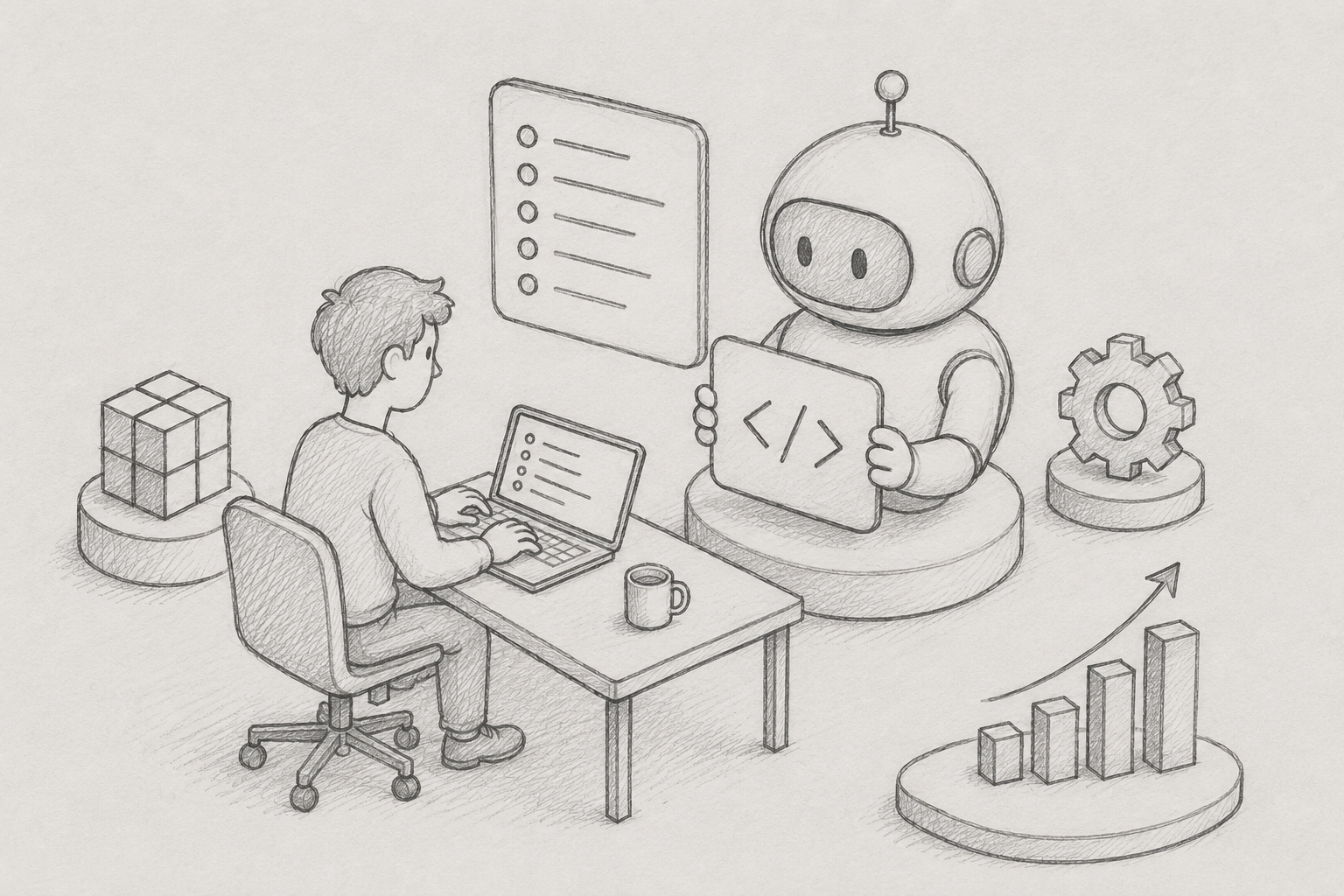
For veterans with 20 years of experience, this is not a crisis but an opportunity to achieve 'superhuman productivity.' Senior engineers should now spend more time on 'design and verification,' breaking free from the quagmire of 'implementation.' They need to utilize AI agents like skilled interns to handle tedious coding tasks, allowing themselves to transform into 'system orchestrators' who focus on the overall system's stability, scalability, and business value creation.
Conclusion: Beyond technical fear, towards a creative partnership
The profession of software developer will not disappear. However, the narrow definition of 'someone who types code' will vanish. We are evolving into 'software architects' and 'problem solvers' who view problems from a broader perspective and leverage AI as a powerful assistant to create more complex and magnificent systems.
The pace of change is indeed frightening. However, the history of technology has always favored those who understand and utilize tools first and most deeply, rather than those who reject them. Bring AI agents into your development environment right now. And I hope you combine your 20 years of know-how to create software for the new era.
References
1. Andrej Karpathy (2024). 'The Era of Vibe Coding: Why Prompting is the New Compiler'. Tech Insight Blog.
2. Gartner (2025). '2026 Strategic Technology Trends: Autonomous Agentic AI and Software Development'.
3. McKinsey Digital (2024). 'The Developer Productivity Revolution: Generative AI in the SDLC'.
4. IEEE Computer Society (2025). 'Human-AI Collaboration in Software Engineering: Risks and Rewards'.
5. O'Reilly (2025). 'Architecture Patterns for the AI-Assisted Era: Beyond Copilot'.
6. HBR (2024). 'Why AI Will Increase the Demand for High-Level Engineering Talent'.
syhan