
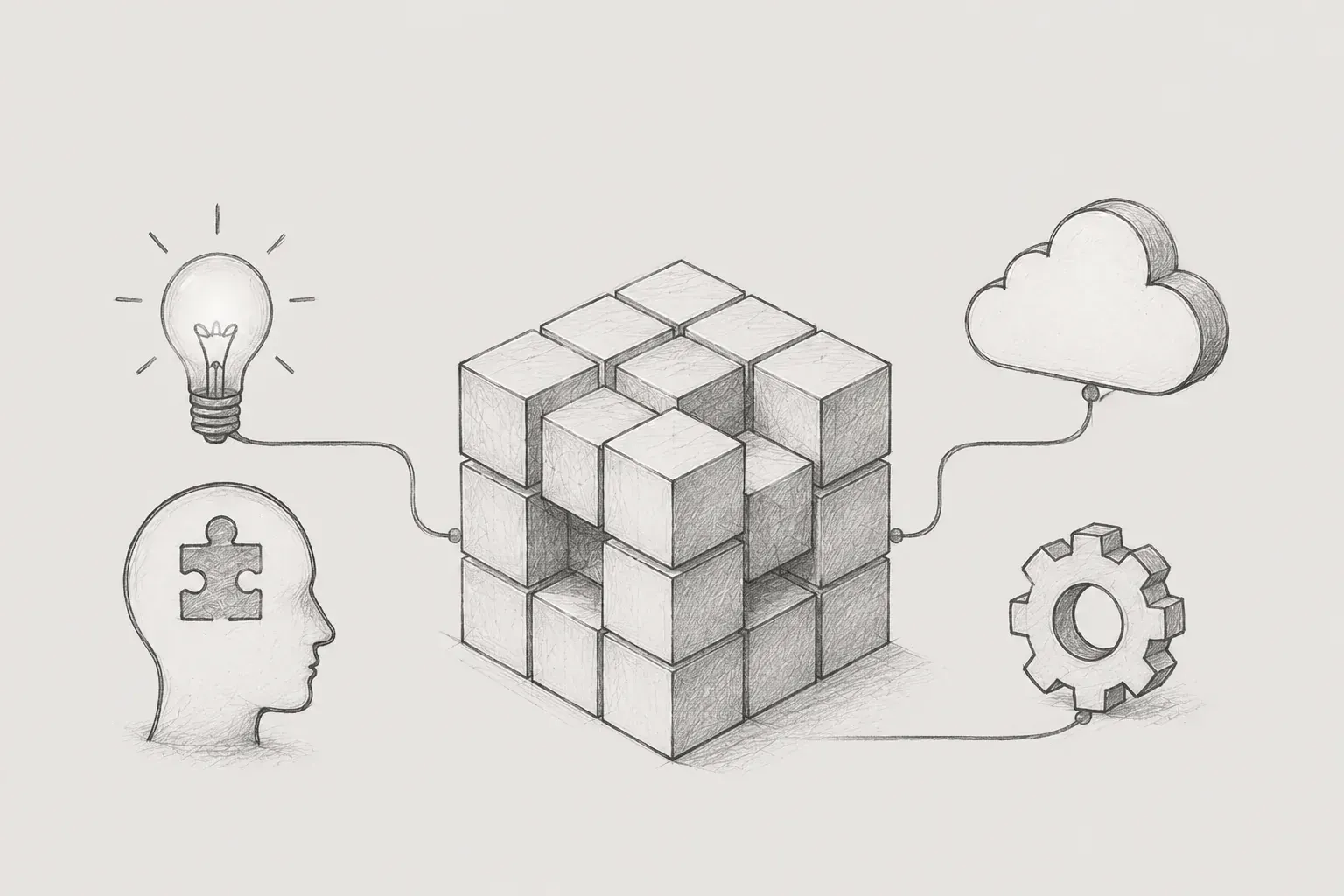
Introduction: The Massive Shift in Software Paradigms
The history of human technological advancement has followed a consistent rule of evolution of tools and the resulting expansion in scale. In the past, carpenters built houses relying on their skilled craftsmanship with just a hand hammer and a single saw. The architecture of that time was entirely dependent on individual capabilities, and completed structures were unlikely to exceed the scale of small standalone homes or small village warehouses. The absolute time and labor efficiency required to complete a single building was also exceedingly low. However, following the industrial revolution and into the modern era, the evolution of construction tools into highly advanced and sophisticated equipment such as cranes, excavators, and concrete pumps has completely transformed the landscape of construction. Today, humanity no longer confines itself to single-story wooden houses of tens of pyeong; large apartment complexes housing thousands of families, skyscrapers hundreds of meters tall, and even vast virtual cities equipped with massive infrastructures are being constructed. These monumental urban structures demand complexity, safety, and an organic management system that were unimaginable with the hammers and saws of the past.
The world of software engineering is also following exactly the same trajectory. The emergence of Generative AI and Large Language Models (LLM) is causing an unprecedented revolution in the software industry. In the early days of AI technology's spread, there was a prevailing extreme prediction, mainly among the media and some extreme optimists, that 'AI will be able to write all code by itself, so human developers will soon completely disappear.' The argument was that since the act of coding itself is automated, the value of engineering will diminish. However, as this initial frenzy has passed and technology has been directly applied to actual practice and large-scale enterprise system development, engineers in the field have begun to realize an important truth. While AI can quickly churn out vast amounts of boilerplate code and rapidly implement specific algorithms, it cannot understand the essence of complexly intertwined business domains, achieve organic alignment between large systems, or autonomously make sustainable architectural decisions. In other words, AI is by no means a substitute for human developers.
On the contrary, the emergence of AI has led to an explosive increase in the overall global demand for software, and paradoxically, the need for developers with advanced capabilities is growing even more. In the past, due to the limitations of cost-benefit analysis (ROI) and the absolute shortage of development personnel, we did not even dare to attempt the digitization of micro-business areas (Hyperniche Domain) or the ultra-large intelligent systems that require interactions among tens of thousands of microservices. However, thanks to the tool of AI, these are rapidly being created in large numbers. Software, backed by the powerful support of advanced tools, will become larger than ever before. This paper discusses this unprecedented large-scale software ecosystem that is expanding at a super-fast pace. "Mega Software"I want to define it as such. And in this mega software era, we need a fundamental shift in perspective on how we view software, a major innovation in development methods and tools, as well as the documentation of developer decision-making and tacit knowledge that arises from the collaboration between numerous AIs and humans, transforming them into organizational assets.'Development Tacit Knowledge Management System'I want to deeply examine the role and specific measures.
1. The Essence of Mega Software and the Paradigm Shift
Mega software does not simply mean a system with a large number of lines of code or a large database capacity. The essence of mega software is that the components within the system are interconnected organically, allowing them to grow and evolve on their own.'The Great Ecosystem and Metropolis'The form it takes is this. While past software was a robustly built 'independent structure' designed to achieve a specific business purpose, mega software is a structurally organic entity that constantly expands, consisting of thousands of microservices, tens of thousands of API endpoints, and numerous autonomous AI agents exchanging data in real-time.
1) Exponential Explosion Mechanism of Software Demand
As the marginal cost of generating source code approaches zero due to AI, all areas of business are now dominated by software. What used to take a week to develop a prototype can now be completed in just a few hours with AI agents. This dramatic increase in productivity allows companies to simultaneously order and operate ultra-precision customized features, real-time data analysis pipelines, and optimized micro-tools for departments and individuals—capabilities that were previously unimaginable. Ultimately, the fragmentation and combination of individual software occur simultaneously, triggering a 'megaization of software' as the overall scale of the system expands exponentially.
2) Dramatic Rise of the Abstraction Layer
Modern developers no longer waste time on low-level memory management, complex network socket communication, or tedious framework setup code. These low and intermediate-level engineering tasks are thoroughly abstracted away and hidden by AI tools. The platform of abstraction on which developers stand has been significantly elevated. Just like in constructing a large building where prefabricated large modules created in a perfectly controlled factory environment are quickly assembled by cranes instead of firing one brick at a time on-site, developers in the mega software era must invest most of their intellectual energy in designing the high-level intentions of the business and establishing architectural relationships between huge domain models. This is a point where a complete shift in perspective from a 'Coder' typing line by line of source code to a 'System Architect' coordinating and controlling the flow of a gigantic system is enforced.
[Table 1] Comparison of Paradigms Between Traditional Software and Mega Software
|
Item |
Traditional Software Era |
Mega Software Era |
|---|---|---|
|
Metaphorical Object |
Independent Single-Story Wooden Structures |
Continuously Expanding Giant Skyscrapers and Virtual Cities |
|
Core Bottleneck Area |
Typing Source Code and Boilerplate Implementation |
Designing Large Domain Models and Controlling Complexity Between Components |
|
Main Role of the Developer |
Writing and Debugging Imperative Code (Coder) |
Defining Declarative Intent and Orchestrating Architecture |
|
Key Architecture |
Monolithic or Early MSA |
Ultra-Massive Multi-Agent Combined Autonomous Evolving Ecosystem |
|
Code Growth Rate |
Proportional to Human Typing Speed (Linear Increase) |
Mass Production by AI Agent Pipeline (Exponential Increase) |
2. Development Methods of Mega Software: From 'Coding' to 'Domain Modeling and Synthesis'
In an environment of mega software where the refinement of development tools has reached its peak, the act of 'From Scratch Coding', rewriting source code from scratch, is gradually becoming an inefficient approach. The main task of humans is to clearly delineate the boundaries of the business domain, provide refined guidelines for the AI to generate code without misunderstandings, and rapidly pivot towards organically composing (Composition) the generated components.
1) Strong Return of Domain-Driven Design (DDD)
As buildings become taller, the construction of piles that penetrate the ground and the core wall structure that supports the load must be perfect. A building raised in height with poor structural design will collapse under even minor vibrations. The same goes for mega software. Since AI churns out code at an astonishing speed, if the domain model to anchor it is not clear, the system will deteriorate into an incomprehensible 'Big Ball of Mud' overnight, leading to disaster. Therefore, the design of the Bounded Context that delineates the conceptual boundaries of the business becomes all the more important.
Human architects must establish a clear domain identity and define a unique language that runs through the system, known as the Ubiquitous Language, for AI not to get lost. For example, instead of indiscriminately using the term generic UI component, we can clearly name the core functional unit within the system as 'Track' and systematically define the most basic atomic-level UI elements that compose this Track as 'Beat'. This meticulously established domain nomenclature and structural hierarchy plays a pivotal role in ensuring that AI generates high-quality source code that penetrates both the frontend and backend without distortion.
2) Declarative Development and LLM-Based Design-to-Code Pipeline
The core of mega software development is the establishment of an automated pipeline that connects human abstract designs and intentions to functioning software objects. When humans design screens using design tools like Figma, the design tokens and the semantic information of the domain model embedded in the screen are immediately interpreted by the AI agent. Humans only declaratively describe the 'Component Mapping' rules, which indicate which data fields correspond to which UI elements, and the constraints of the data model. Based on this, the entire connection chain from React component structure and TypeScript type definitions to backend entity code based on Spring Boot is generated seamlessly by a sophisticated AI pipeline. Humans now take the role of high-level governance entities that validate and approve the consistency of mapping rules rather than being individual code writers.
3. Methods of Utilizing Tools: Fusion of Multi-Agent and Local LLM
The use of tools in the era of mega software goes far beyond a single developer simply having a chatbot (Copilot) turned on next to their editor and using the autocomplete feature. Now, multiple autonomous AI Agents with different expertise collaborate organically.'Multi-Agent System'It must be seamlessly integrated into the development workflow.
1) Overcoming the limitations of the context window and the necessity of local infrastructure
Mega software has a vast codebase of over millions of lines, so sending the entire source code to commercial cloud AI services every time to understand the context faces serious limitations in terms of cost, security, and latency. Therefore, companies can perfectly block the internal leakage of source code assets while being able to index gigabytes of code context in real time.'Local LLM Operation Environment'We are building this as a necessity. The reason is to attract high-performance local AI computing equipment such as NVIDIA's DGX Spark and to optimize and run lightweight and efficient model execution engines like `Ollama`. Only by basing ourselves on this powerful local computing power can next-generation CLI-based AI agent tools, such as `Claude Code`, which autonomously perform tasks combined with the developer's terminal, demonstrate their capabilities while fully mastering the context of the entire project's source code.
2) Multi-Agent Based Role Distribution and Collaboration Architecture
When a human architect defines the high-level domain specification and business intent and inputs it into the system, the main lead agent receives it and precisely breaks it down into detailed task units that need to be implemented. Subsequently, the broken-down tasks are dispatched to each specialist agent according to architectural rules. There is a coding agent dedicated solely to source coding, rapidly writing React or Spring Boot code, a testing agent that analyzes boundary conditions and edge cases of the written code to perfectly write unit and integration test code, and a security validation agent that monitors security vulnerabilities and architectural violations in real-time through static analysis. Throughout this process, the human developer's role is completely elevated to that of a 'conductor' who reviews the outputs of individual agents and fine-tunes the guidelines.
4. Key Recommendations: The Necessity and Central Role of Developing a Tacit Knowledge Management System
As discussed earlier, in a mega software environment where AI Agents exponentially produce countless source codes and human architects command them, the scale and complexity of the system far exceed the cognitive limits of one or two humans. At this point, the most critical risk factor determining the sustainability of software is precisely "The phenomenon of countless 'decisions' made during the development process and the 'tacit knowledge' of engineers being lost"is.
No matter how advanced the AI agent is, if it does not understand the 'contextual background' of why human developers made certain sacrifices in performance at specific times, such as changing the communication method between microservices from synchronous (Sync) to asynchronous (Async), or why exceptions were allowed in certain component mapping rules, it can lead to a 'hard-to-notice hallucination' that creates critical source code that completely violates the original design intent when refactoring or enhancing the code later. As the infrastructure grows larger, the fragments of knowledge buried in unseen areas become ticking time bombs that can collapse the entire system. Thus, to successfully implement and operate mega software stably, it is essential to systematically capture and asset the numerous technical decisions made within the company and the tacit knowledge that exists only in the minds of individual developers.'Development Tacit Knowledge Management System (Tentative)'Its presence is absolutely necessary, and this system must serve as the heart of the mega software architecture.
1) Core functions and operating mechanisms of the development tacit knowledge management system
The implicit knowledge management system for development is not just a boring and manual documentation tool where developers retroactively write their development logs in Word documents or on Wiki pages. Such a method cannot keep up with the explosive code production speed of mega software and only adds another form of harsh workload on busy developers. The implicit knowledge management system in the era of mega software completely integrates into the developer's daily workflow, allowing knowledge 'Active Capture'It should be an intelligent system.
-
Autonomous Intelligent Assetization of Architecture Decision Records (ADR):When a developer modifies code or changes architecture design within the IDE environment, the system comprehensively tracks the Slack conversation logs, discussion content of Jira tickets, Git commit messages, and the context of prompts exchanged with the AI Agent. Based on this, the AI autonomously drafts an Architecture Decision Record (ADR) for the question "Why was this `Segment` structure changed?" and presents it to the developer, who can give a light approval for immediate incorporation into the enterprise-wide Knowledge Graph.
-
The formalization and context indexing of tacit knowledge:The senior engineer semantically analyzes the history of a troubleshooting session conducted in a local environment to debug specific complex legacy code or to resolve edge cases that AI could not solve, based on console logs and source code changes. This allows for the automatic extraction of the engineer's debugging know-how and hidden dependencies between components, transforming them into 'explicit knowledge'.
-
Knowledge Feeding Interface for AI Agents:The assetized tacit knowledge is not just for humans. The development tacit knowledge management system provides a refined RAG (Retrieval-Augmented Generation) context pipeline in real-time to the locally running LLM and multi-agent system within the organization. Before the AI agent codes new features, it receives the highly contextual constraint from the tacit knowledge system, such as, "Three months ago, Chief Engineer Kim imposed limitations on the lifecycle of the Beat Component due to these failure cases," ensuring that it generates code safely within the guardrails.
The necessity and quantitative value of developing an explicit knowledge management system
The establishment of this system is directly linked to the survival of companies operating in the mega software environment. Firstly, Blocking the Source of Human Error and AI HallucinationIt is. When the scale of the source code increases to hundreds of millions of lines, humans forget even the architectural decisions they made a month ago. If the tacit knowledge management system tightly connects the history of decision-making with a knowledge map, it can fundamentally defend against architectural collapse by warning that it "conflicts with past decisions" when AI tries to change the system in an unintended direction. Secondly, Minimizing Risks Associated with Developer Job ChangesWhen the tacit knowledge held by a single key architect disappears at Mega Software, a catastrophe occurs similar to the disappearance of a power grid blueprint in a large city. If the system continuously absorbs the developer's tacit knowledge as part of the organization's digital assets, even in the event of personnel changes, new personnel and AI agents can query the knowledge graph to maintain the same productivity immediately as the existing context. Thirdly, Dramatic onboarding cost reductionThe new developer, instead of spending months sifting through source code to understand the system's immense architecture and numerous component mapping rules, can ask the tacit knowledge management system, 'Please explain the context behind why our system's segment architecture is designed the way it is now,' allowing them to synchronize years of project context in just a few days.
5. Management and Governance Strategies: Complexity Control and Software Sustainability
No matter how excellent an architecture and tacit knowledge management system you have, a large system naturally follows the law of entropy, where disorder increases if left unattended. The management of mega software should focus on establishing a strict and automated governance system to ensure the 'sustainability of software.'
1) Automated Guardrails that respond to code production speed
The amount of source code that a human developer can write in a day has clear physical limits, but the amount of code produced by a multi-agent pipeline is limitless. This asymmetry in speed can lead to severe technical debt accumulation. Therefore, automated architectural guardrails should be tightly placed across all stages of the Continuous Integration and Continuous Deployment (CI/CD) pipeline. For example, in a Java-based Spring Boot environment, architecture validation frameworks like `ArchUnit` should be actively introduced to enforce rules such as "the domain layer must not depend on the details of the infrastructure layer" or "all component mappings between frontend elements and the backend must pass the constraints registered in the company's standard rules and tacit knowledge systems" at the unit test level, enforcing checks at compile time. Code that does not pass quality gates must be rigorously rejected, regardless of whether it was written by AI or a human.
2) Academic Perspective of Software Engineering and Future Ecosystem
The proverb we should engrave most deeply in this era is the literature compiled by Google's engineering leaders.'Software Engineering at Google'It is the core philosophy that appears in . They defined "software engineering not just as the act of writing code, but as the technique of sustainably managing code amidst evolving costs over time and changes within the organization." Even after ten years, twenty years, with countless developers changing and AI models being upgraded dozens of times, sustainability that allows massive systems to continue driving business growth without collapsing. That is the ultimate goal all engineers and IT leaders living in the mega software era must achieve.
Conclusion: The Birth of the Super Architect and Preparations for the Future
As the era of hammers and saws has passed, giving way to the age of tower cranes and 3D printing in construction, the traditional software development era centered around simple typing is completely fading away in the face of the massive wave of mega software. Generative artificial intelligence will never destroy developers. Instead, it perfectly frees developers from the tedious and repetitive low-level bottleneck of coding, guiding us into a world of ultra-large systems that humanity has never dared to challenge before. The era of simple coders is coming to an end, but it is clear that the domain of the entire system is being distinctly divided, designed, and orchestrated with organizational knowledge.'Super Architect'The era has just begun to shine brilliantly.
References
1. Evans, E. (2003). Domain-Driven Design: Tackling Complexity in the Heart of Software. Addison-Wesley Professional.
2. Winters, T., Manshreck, B., & Wright, H. (2020). Software Engineering at Google: Lessons Learned from Programming Over Time. O'Reilly Media.
3. Karpathy, A. (2017). Software 2.0. Medium.
4. Fowler, M. (2014). "Bounded Context". martinfowler.com.
5. Richards, M., & Ford, N. (2020). Fundamentals of Software Architecture: An Engineering Approach. O'Reilly Media.
6. Wooldridge, M. (2020). A Brief History of Artificial Intelligence: What It Is, Where We Are, and Where We Are Going. Flatiron Books.
7. Newman, S. (2021). Building Microservices: Designing Fine-Grained Systems (2nd ed.). O'Reilly Media.
syhan