
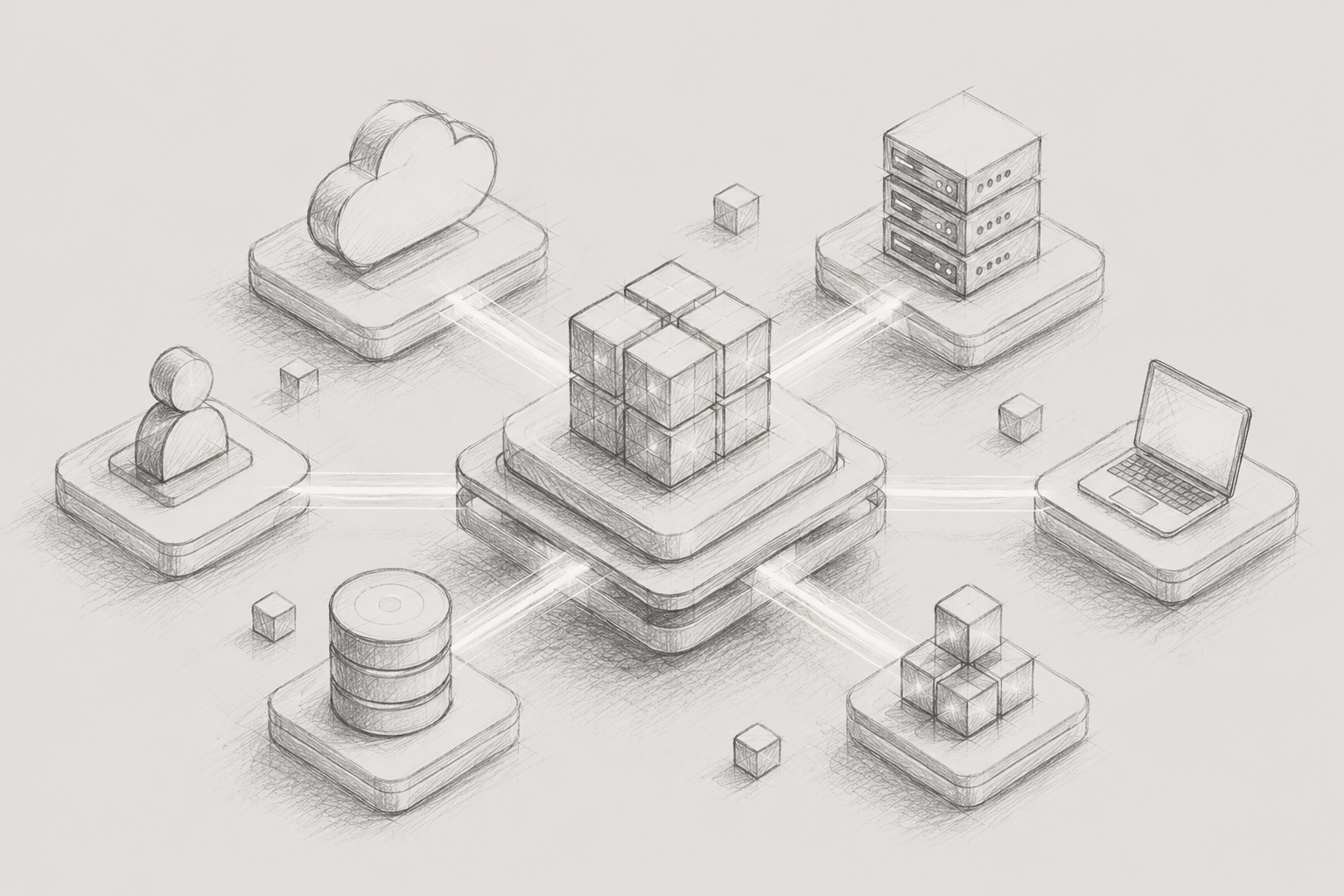
The evolution of AI collaboration infrastructure
-From simple context injection to a team-wide AI development and operation platform-
Nowadays, AI agents like Claude, Codex, and Cursor write, review, and test code. Their technical capabilities are impressive. However, when working with AI on large-scale platforms, their limitations quickly become apparent.AI starts each session with a clean slate, knowing nothing.
The Vizend team created this to solve the problemvizend-agent-hubThis is a Claude Code plugin with 17 Skills, 8 Agents, and 9 Hook scripts based on v0.4.0, designing a four-step advanced roadmap including Meta-Harness independence and team quality feedback loops.
1. Problem — The reality of working with AI
|
The AI agent starts each session with no prior knowledge. |
In single-service or small-scale projects, it can be explained with prompts. However, the situation changes in large-scale platforms involving dozens of services.
|
① |
The AI converges to a general single-app pattern (src/components, src/pages). Vizend's core is the workspace structure based on episodes/dramas/libraries, and I had to explain this difference every time. |
|
② |
There is no basis or reference documents for the chosen structure. Results are produced, but there is no 'explainable development process'. |
|
③ |
Operational flows such as pausing, resuming, and approval requests cannot be handled with one-off AI calls. A planning→implementation→evaluation→approval point was necessary in long-term tasks. |
This issue is Prompt trickIt cannot be solved. It must be addressed structurally.
▌ "Isn't Claude/Codex itself a harness?"
That's right. Claude Code and Codex already have powerful harnessing capabilities. There is nothing missing.
|
Function |
Claude Code / Codex |
+ vizend-agent-hub |
|---|---|---|
|
Agent Loop · File Read/Write |
✅ |
✅ |
|
Session State Management |
△ Limited |
✅ Auto Save·Restore |
|
Vizend domain knowledge (layer, service, convention) |
❌ |
✅ 17 Skills |
|
Service Interconnection Patterns |
❌ |
✅ cross-service-context |
|
Team Common Validation Criteria |
❌ |
✅ vsr-check |
There is a tool, but, Tools that know our codeIt is not. The vizend-agent-hub adds a Vizend-specific configuration layer on top of Claude/Codex. By simply modifying one skill file, it is instantly applied to the entire team.
2. Current vizend-agent-hub — v0.4.0
Initially, it was simply for having AI read the Vizend architectural documents. Now, it has grown into a collection of Skills, Agents, and Hooks that automatically run on top of the Claude Code plugin system.
▌ Skills — 17 items
In the session /vizend-agent-hub:skill-name It is called directly or automatically routed when the Hook detects the keyword.
|
Category |
Skill |
Role |
|---|---|---|
|
Domain context |
service-catalog |
Summary of service list, responsibilities, and dependencies |
|
architecture |
Layer structure (Facade→Feature→Store→Boot) + dependency direction rules |
|
|
conventions |
CDO/VO/SDO/RDO naming, package convention |
|
|
coding-standards |
Java 21/Spring Boot coding standards |
|
|
glossary |
Quick Reference for Domain Terminology |
|
|
development workflow |
hub-index |
Skill Routing Meta Hub - Guidance on Which Skill to Use |
|
dev-loop |
Plan→Implement→Verify Autonomous Iteration Loop |
|
|
git-workflow |
Branch strategy·Conventional Commits·MR rules |
|
|
cross-service-context |
Multi-Service Scenario Context Loading |
|
|
Quality / Validation |
vsr-check ★ |
Automatic detection of category 8 violations — code evidence only, inference reporting prohibited |
|
security-review |
JWT authentication security vulnerability detection |
|
|
verification-loop |
Build·Test·Lint·Security·Layering 6-Step Full Loop |
|
|
create-integration-test |
Create a test based on Flow/Seek/Action @SpringBootTest |
|
|
Automation / Generation |
sync-domain-docs |
Domain Code ↔ Document Synchronization |
|
flyway-script |
Flyway Migration Script Writing Guide |
▌ Agents — 8
A specialized instance isolated from the main context. It operates proactively in a way that invoking the code-reviewer automatically occurs when the code is modified, returning only the results after independent analysis.
|
Agent |
Role |
Automatic Trigger |
|---|---|---|
|
planner |
Generate TASK.md · Pre-flight diagnosis · Classification of Scope |
Multi-step·Multi-service operation |
|
code-reviewer |
Layering·Naming·Test Consistency Review |
Automatic after code writing·modification |
|
security-reviewer |
JWT·StageContext·authentication vulnerability detection |
authentication code, new API endpoint |
|
violation-detector |
Evidence-based violation detection for category code 8 |
Internal execution of vsr-check |
|
tdd-guide |
Guide to the Red-Green-Refactor cycle |
New features, bug fixes |
|
integration-test |
@SpringBootTest based test scaffolding |
Writing Flow/Seek/Action tests |
|
architect |
system design and technical trade-off analysis |
Change of dependency structure, new service |
|
refactor-cleaner |
Remove dead code and reduce complexity |
Large-scale cleanup before release |
▌ Hook — An automatically triggered invisible hand
Unlike Skill·Agent, Hook automatically executes for each session event without user invocation. The harness directly executes the script without AI judgment.
|
Event |
Action |
|---|---|
|
SessionStart |
Automatic injection of Vizend context · Restoration of previous session state · Hub version check · Workspace health check |
|
UserPromptSubmit |
Service name keyword detection → related Skill routing suggestion |
|
PostToolUse |
Save TASK.md snapshot when modifying files (in case of session interruption) |
|
PreCompact |
Preservation of core progress state before context compression |
|
Stop |
TASK.md Checkbox Drift Detection · Incomplete Reminders · Session State Saving |
When the session starts, the Vizend context is automatically injected and the previous task state is restored. Even if the session suddenly ends, the TASK.md at the last snapshot point is automatically recovered in the next session.
3. Before and after comparison — actual development scenario
Scenario: "Please add a new subscribe API to the gallery"
|
No harness |
With harness |
|---|---|
|
• AI: generated with standard Spring Boot pattern • "We need to use the Facade-Feature layer" • "@AuthorizedRole is missing" • "Need to extract pavilionId using StageContext" • "We need to pass the event to qra-backend" • … modify repeatedly → Redirection 5-6 times · Session 1 hour+ |
• [Hook] Automatic context injection + 'gallery' detection → Skill recommendation • AI: "SubscriptionPvsFlow + @AuthorizedRole + EventProxy" Should we handle the integration with qra-backend?" • Developer: "OK" • Create all Command·Resource·Flow·Logic·events • [Hook] Automatic execution of vsr-check → 0 violations → Re-instruction 0~1 times · Session 15~20 minutes |
▸ Violation items of the first code generated without a harness
This is the result of scanning the code generated without a harness in the same scenario with vsr-check. No violations found under the same conditions when using a harness.
|
# |
Violation Item |
Category |
|---|---|---|
|
1 |
Directly call the Repository without separating layers in the Facade |
Architecture CRITICAL |
|
2 |
@AuthorizedRole missing — open API |
Security CRITICAL |
|
3 |
Use of Request/Response DTO (not CDO/CommandRequest) |
Product |
|
4 |
Direct creation of domain Entity — No logic involved |
Architecture |
|
5 |
cross-service event publishing missing → qra-backend integration disruption |
Product CRITICAL |
Core: The harness first injects context, Skill applies the rules, and vsr-check validates the results. It is not necessary to explain 'how to do it' every time.
▸ Comparison of Three Perspectives
|
❌ Without Harness |
✅ When using the harness |
|
|---|---|---|
|
Productivity |
||
|
Session Start Cost |
Service Structure Explanation Each Time (10-15 Minutes) |
Hook automatic injection (0 minutes) |
|
First code quality |
General Spring → Modify Repeat |
Vizend Pattern from the Beginning |
|
Number of redirect attempts |
5-6 times |
0-1 times |
|
team maintainability |
||
|
Layer consistency |
Varies by developer |
Fixed Facade→Feature→Domain |
|
Naming Consistency |
DTO/Request Mixed |
CDO/VO/CommandRequest Consistent |
|
Role Suffix |
Random (Service/Handler) |
PvsFlow/DvpFlow/PeerFlow fixed |
|
Potential for development |
||
|
Add new service |
Need to re-explain the rules |
Instantly in one page AGENTS.md |
|
AI tool switch |
Re-entry of rules required |
Share AGENTS.md — zero cost |
|
Rule update |
Dependence on prompt skills |
Modify 1 Skill file → Apply to the entire team |
▸ Changes confirmed by numbers
|
Item |
Previous |
After |
|---|---|---|
|
Number of service guide documents |
3 items |
82 items (total service coverage) |
|
Public Skill |
0 items |
17 items |
|
Specialized Agent |
0 items |
8 items |
|
Automatic Hook Script |
0 items |
9 items |
|
PR violation detection |
Manually check |
vsr-check 8 categories automatic |
|
Session interruption recovery |
Manual re-explanation |
Automatic Recovery of TASK.md Snapshots |
|
Cost of Transitioning to AI Tools |
Reenter rules needed |
Share AGENTS.md - zero cost |
|
Number of first code layer violations |
Average of 5 to 7 cases |
0 cases |
4. Future — Advancement Roadmap
Phase 1 is completed. The remaining 3 key constraints will be addressed in Phase 2 to 4.
|
Step |
Goal |
Content |
|---|---|---|
|
Phase 1 ✅ Completed |
Knowledge·Role·Verification·Status Layer |
17 Skills · 8 Agents · 9 Hooks · 82 Documents "AI has context and remembers previous tasks" |
|
Phase 2 🔨 Short-term |
Quality enhancement + feedback loop |
Hook profile (minimal / standard / strict) + automatic detection of correction events → automatic submission of Hub repository MR "Corrections lead to improvements in team hub quality" |
|
Phase 3 📐 Mid-term |
Separation + CI Integration Layer |
Meta-Harness standalone plugin extraction + CI document automation + MCP (GitLab·Jira·build results) "AI sees the system directly" |
|
Phase 4 🚀 Long-term |
Orchestration Layer |
Parallel Agent Execution + Pattern Automatic Extraction + Team Shared Harness Server "AI becomes the team's infrastructure" |
▌ Core Design Direction: Meta-Harness
The most important goal of Phase 3 is to completely separate the currently mixed structure into two layers.Meta-HarnessWhen it becomes an independent plugin, other teams can simply add their own domain knowledge hubs.
|
Meta-Harness — Universal AI Collaboration Infrastructure Session Management · TASK Management · Hub Quality Feedback · Memory · Skill Router | Project Independent |
|
↑ depends on ↑ |
|
vizend-agent-hub — Vizend domain context service-catalog · architecture · conventions · vsr-check etc. 17 Skills + 8 Agents |
▌ Team Quality Feedback Loop
Current session corrections are volatile. In Phase 2, we will introduce a 3-stage loop that automatically detects correction events, leading to overall quality improvement for the team.
|
A. Detection Stop Hook automatically scans for correction signals |
→ |
B. Local archiving proposals/ Developer confirmation → confirmed |
→ |
C. Contribution Submission /hub-feedback submit Hub ㅈ MR automatic creation |
Correction signal ('no', 'that's not it') detected by Stop Hook → Saved locally → Developer confirms and automatically generates MR in Hub repo. Corrections from any team member's session contribute to hub quality improvement.
▌ Token savings — Offloading Vista Rule-Base code
Claude reads and analyzes all the boilerplate code automatically generated by Vista (the code generation tool).Patterns already knownIt is a waste of unnecessary tokens in (JPA Repository, setter/getter, Vista standards).
|
Direction |
Content |
|---|---|
|
Short-term measures |
Exclude the generated directory with .claude-ignore or skip_paths in Skill Add a guideline in conventions Skill stating "Vista generated files do not require analysis" |
|
Option A script separation |
Separate Vista/CRUD pattern into Python script → Claude only receives the execution result Marking .generated in the generated file → apply read skip |
|
Directly link Option B to Vista |
Generate code with Vista API call → Claude reviews only the diff Specify the list of Vista generated files in bootstrap Skill → Exclude from violation-detector checks |
Not leaving the areas that the rule-based tool can handle to Claude.This is the design principle that significantly reduces the cost of AI collaboration.
5. Conclusion
|
vizend-agent-hub is not a 'tool that makes good results for AI'. It is an operational infrastructure that creates a repeatable and explainable development process. Without a harness, AI writes code quickly. With a harness, AI writes Vizend code from the beginning. AI is not just a simple generation tool; it becomes a far more powerful development platform for the entire team when appropriate context and control plane are combined. |
Reference
github.com/garrytan/gstack · agents-community · vizend-agent-hub · todo-projects · oh-my-claudecode · everything-claude-code
James