
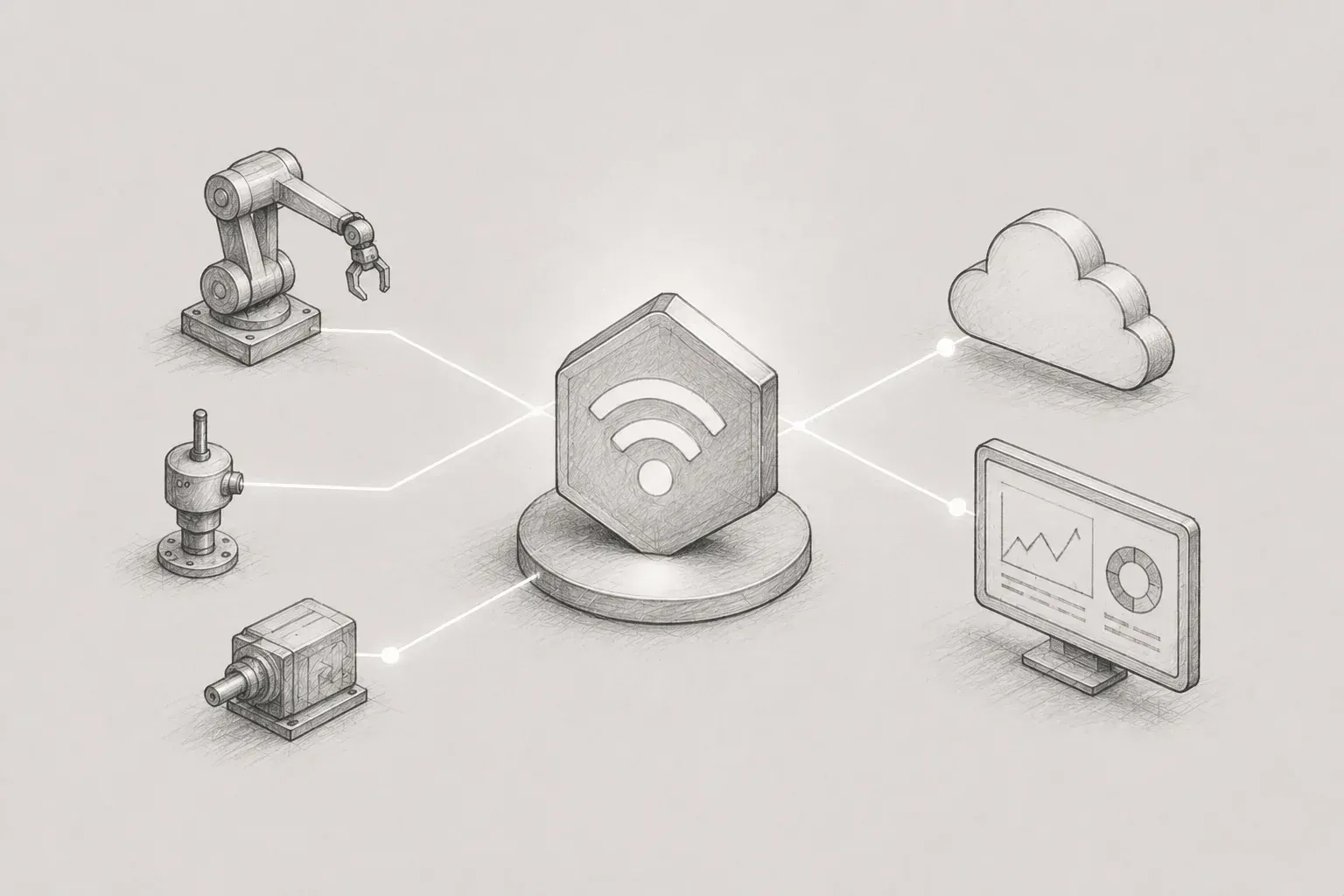
1. Industrial IoT and Data Collection
Recently, IoT technology is being used for various purposes such as monitoring equipment status, analyzing production data, and remote management in manufacturing sites. Equipment such as PLCs, sensors, and robots continuously generate data, and effectively collecting and utilizing this data is one of the key elements in building smart factories.
However, various manufacturers' equipment and different communication protocols coexist in industrial sites, and collected data often needs to be utilized simultaneously across multiple systems such as monitoring systems, data storage, and analysis systems. Therefore, a communication method that can efficiently deliver data between equipment and systems is necessary.
MQTT (Message Queuing Telemetry Transport) is a widely used messaging protocol that meets these requirements. Based on its lightweight structure and high scalability, it plays a key role in data collection and transmission in industrial IoT environments.
2. Characteristics of Industrial IoT Environments
The data collection environment in industrial sites has different characteristics compared to general IT services.
2.1 Coexistence of Diverse Equipment
In the field, various equipment such as PLCs, sensors, industrial PCs, and robots are operated together. Additionally, the protocols used may vary by manufacturer, which can complicate the data collection process.
2.2 Generation of Large Amounts of Data
Numerous data points such as equipment status values, production information, quality data, and alarm information are continuously generated. Especially as the number of production facilities increases, the amount of data to be processed also increases.
2.3 Network Constraints
Not every site provides a stable network environment. Some sites may have to consider limited bandwidth or temporary network failures, and reliable data transmission is required even in these conditions.
Due to these characteristics, lightweight and efficient communication protocols are required in industrial IoT environments.
3. What is MQTT?
MQTT stands for Message Queuing Telemetry Transport, a lightweight messaging protocol designed to efficiently transmit data even in constrained network environments. It was initially developed for use in environments with limited bandwidth and unstable connections, such as satellite communications, and has now become one of the most widely used communication protocols in the IoT field.
In a typical Client-Server model, the client and server are directly connected and exchange data. In contrast, MQTT operates around a Broker, separating the Publisher that generates data from the Subscriber that receives data.
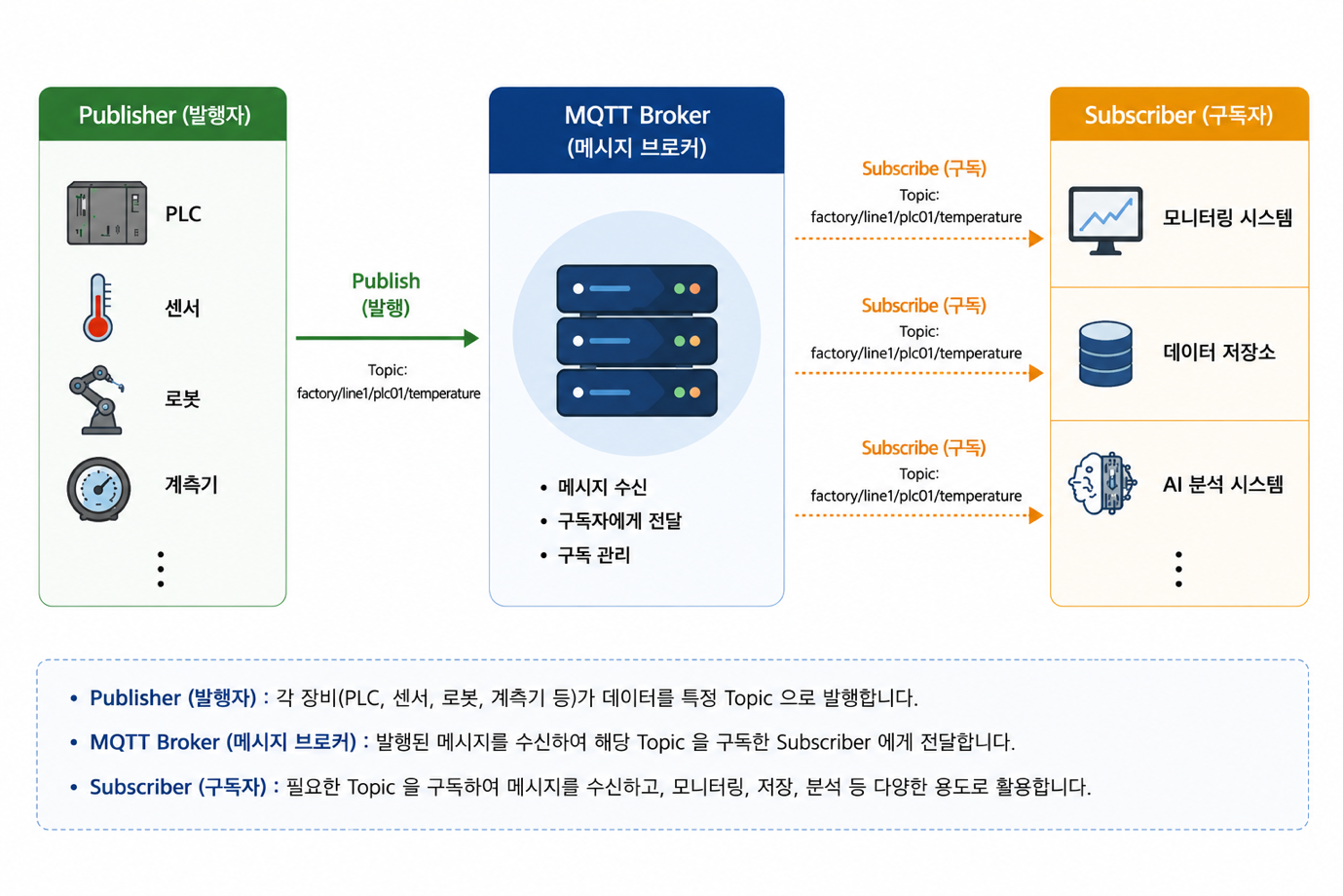
The Publisher publishes data to a specific Topic, while the Subscriber subscribes to the Topics of interest to receive the necessary data. The Broker performs the role of receiving messages and delivering them to the appropriate Subscriber during this process.
Through this structure, the Publisher and Subscriber do not need to directly know of each other's existence, thus enhancing the system's scalability and flexibility.
4. Key Features of MQTT
4.1 Publish/Subscribe Structure
MQTT operates based on the Publish/Subscribe method. In a typical Client-Server architecture, clients must communicate directly with a specific server, but in MQTT, a Broker sits between the Publisher and Subscriber to relay messages.
In this structure, senders and receivers do not need to be directly aware of each other, which helps reduce the coupling between systems. Moreover, when new systems are added, there is no need to modify existing systems, making it highly scalable.
For example, if data from a single device is sent to an MQTT Broker, monitoring systems, data storage systems, AI analysis systems, etc., can simultaneously subscribe to and utilize the same data. Consequently, the range of data utilization broadens, and the system configuration becomes more flexible.
4.2 Lightweight Protocol
MQTT is a lightweight protocol designed to reliably transmit data even in constrained network environments. The fixed header of MQTT control packets is extremely small, at a minimum level of 2 bytes, and the protocol structure is also configured simply.
In contrast, typical HTTP communication must transmit various header information during the request and response process, using relatively more network resources. Thus, MQTT is suitable for IoT environments that require continuous data transmission at short intervals.
Furthermore, MQTT reduces communication overhead compared to creating a connection for each request because it maintains a connection between devices and the Broker while exchanging data.
For example, assuming that 1,000 devices in an industrial setting transmit data every second, MQTT can deliver data while minimizing network usage through smaller header sizes and persistent connection methods.
4.3 QoS (Quality of Service)
In industrial IoT environments, different levels of transmission reliability are required based on the importance of the data. MQTT allows the selection of the message delivery guarantee level through QoS (Quality of Service).
- QoS 0: At Most Once
- QoS 1: At Least Once
- QoS 2: Exactly Once
QoS 0 is the fastest method with potential message loss, but less network overhead. It is mainly used for continuously generated information like sensor data.
QoS 1 guarantees that messages are delivered at least once, and if retransmission occurs due to network issues, duplicate receipts are possible. It is one of the most commonly used levels in industrial sites.
QoS 2 guarantees that messages are delivered exactly once, providing the highest reliability. However, the processing is complex which may increase network and system load, so it is used restrictively for critical events or control commands.
By selecting an appropriate QoS level according to system requirements, a balance between performance and reliability can be achieved.
4.4 Topic-based Messaging
Since MQTT manages messages based on Topics, it can be systematically differentiated according to the nature of the data or type of equipment. This allows for selective receipt of only the necessary data, and efficient data management even in large-scale equipment environments.
For example, a Topic structure can be constructed based on criteria such as production line, type of equipment, and measurement items, as follows:
- factory/line1/plc01/temperature
- factory/line1/plc01/alarm
- factory/robot01/status
MQTT's Topics can also be organized in a hierarchical structure, allowing for more systematic data management. For example, if differentiated by factory (factory), production line (line), equipment (plc, robot), and data type (temperature, alarm, status), it is possible to selectively subscribe to data from specific equipment or specific production lines.
5. Reasons for MQTT's Usage in Industrial IoT Environments
5.1 It can reduce inter-system coupling.
Since MQTT communicates around a Broker, there is no need for the Publisher and Subscriber to connect directly. Therefore, even if a new system is added or an existing system is changed, the impact on other systems can be minimized.
This characteristic acts as a significant advantage in industrial IoT environments where system expansion or maintenance occurs frequently.
5.2 It has excellent scalability.
Even if the number of data consumers increases, the Publisher does not need to change. Therefore, monitoring systems, data storage systems, AI analysis systems, etc., can simultaneously utilize the same data.
Also, even if new systems are added, there is no need to change the existing data collection structure, allowing for flexible system configurations.
5.3 It is suitable for real-time data collection.
MQTT can efficiently transmit data with minimal network resources, making it suitable for real-time data collection.
It can efficiently deliver real-time data such as equipment status information and can be utilized even in environments where data from hundreds to thousands of devices is collected. This characteristic is effectively utilized in areas such as manufacturing equipment monitoring, equipment status analysis, and anomaly detection.
5.4 It works well with Edge Computing environments.
In industrial sites, a structure is widely used where data is collected through an Edge Gateway and then delivered to the cloud or central system using MQTT.
By delivering data collected in Edge environments to multiple systems through the MQTT Broker, data utilization can be enhanced, and an integrated data management environment can be established in connection with the cloud.
6. Considerations when using MQTT
MQTT is a very useful protocol, but there are several factors to consider in real operating environments.
- Topic system design
- Selection of QoS Levels
- Broker Redundancy and Operational Strategy
- Implementation of TLS-based Security
- User Authentication and Authorization Management
In large-scale equipment environments, it is important to design the topic structure consistently. If the topic system is not clearly defined, data management and operations can become complex as the number of devices increases.
It is also necessary to select an appropriate QoS level based on the importance of the data and establish an operational strategy to prepare for broker failures to ensure stable service operations.
7. Conclusion
MQTT is used as a key technology to flexibly connect various devices and systems in industrial IoT environments, beyond just a simple message transmission protocol.
In particular, the Publish/Subscribe structure reduces the coupling between systems and ensures scalability and real-time performance, making it suitable for smart factory environments.
Additionally, based on its characteristics as a lightweight protocol, efficient data transmission is possible even in constrained network environments, and it is widely used in industrial IoT environments where various devices and systems need to be connected.
As Edge Computing and AI-based data analysis technologies expand in the future, the scope of MQTT usage is also expected to broaden. Understanding the characteristics of MQTT and applying them appropriately when designing industrial IoT systems will enable the establishment of a more stable and scalable data collection environment.
genie