

Smart Ship Solution (hereinafter SS) Data Integrity Management – From Missing Data Detection to Recovery, Validation, and Anomalous Data Detection
On ships, navigation, engine, and equipment data is continuously generated by various systems, including IAS, VDR, and ACONIS. SS is an onboard–shore integrated data platform that collects, standardizes, and processes this data onboard, uses it in services such as machinery management, navigation management, and vessel management, and transmits the required data ashore.
However, ensuring data reliability in a shipboard environment cannot be solved simply by determining whether the data was “sent” ashore. Network disconnections or delays can occur between the ship and shore, and data can also be lost in the onboard collection and processing Pipeline.
Ultimately, there are three things that must be verified.
Was the data generated normally when it was needed, was it delivered completely from onboard to shore, and is the value that arrived ashore itself valid data that can actually be used?
In SS, this issue is broadlyData Missing and Recovery Managementand is managed through two functions: data anomaly detection management and data missing and recovery management.Data Missing and Recovery Managementis responsible for the integrity of data collection, transmission, and recovery, while data anomaly detection management checks whether collected sensor values are anomalous.
In other words, rather than providing merely a data transmission function, SS establishes a data reliability management framework that continues throughmissing data detection → cause tracing → recovery → recovery validation → data quality verification.
1. Why “Transmission Successful” Alone Is Not Enough for Ship Data
SS’s data flow begins with shipboard equipment. Data generated by IAS, VDR, ACONIS, and other systems passes through the onboard sensor data collection module to the onboard data processing module, where it is processed into raw time-series data and periodic aggregated data. It is then used by domain services such as machinery management and navigation management, or transmitted ashore through ship–shore communications.
From an operational perspective, the particularly important target is1-minuteperiodic aggregated data.
Data Missing and Recovery Management is defined as a function that verifies, for each ship, whether the daily 1-minute data is collected normally all the way ashore, identifies the point of loss when data has been lost, and performs retransmission.
A day converted into minutes is as follows.
24 hours × 60 minutes = 1,440 records
Therefore, if all of the data for a past day was collected normally, 1,440 Timestamps should exist.
However, determining integrity in practice is more detailed than simply checking whetherCount = 1440.
When thetime/interval aggregation data generated onboard arrives ashore, the receiving Timestamp is recorded. Loss is determined based on the actual reception times after excluding duplicate Timestamps. Rather than confirming data loss based on a single indicator, SS checks the data reception status, Backfill events, recovery history, and Pipeline status together.
Therefore, SS data integrity management begins with the following question.
If even one of the 1,440 data points in a day is missing, how will the system detect it, determine where it was lost, and recover it?
2. Stage 1 — The Starting Point of Integrity Management Is “Making Missing Data Visible”
To manage data integrity, missing data must first bevisible.
Data Missing and Recovery Managementprovides three perspectives for this purpose.
Overview shows the status of each ship as of the current time, Daily shows the 1-minute data collection status for the selected date, and Recovery Status (On-Board) shows the onboard recovery status.
Through these views, operators can determine not only that “there is a problem with data collection,” but also
which ship → on which date → how many data points are missing, step by step.
What is important here is not simply the existence of a failure, butspecifying the scope of the failure. In an environment managing data from hundreds of ships, it is difficult to take actual action based solely on a simple Error message.
On the other hand, if the scope of the missing data can be narrowed down by ship, date, and Timestamp, subsequent cause analysis and recovery procedures become much clearer. Therefore, the first principle of data integrity management in SS can be summarized as follows.
“We do not stop at knowing that data is missing; we identify which ship’s data and which time period are missing.”
3. Stage 2 — Do Not Stop at1440 → 1439; Track the Missing Interval
If there should be 1,440 records but there are only 1,439, we can tell that one record is missing.
However, this alone is not enough to recover from the incident.
For recovery, we need to determine which Timestamp is missing and how far that data was successfully delivered through the Pipeline.
SS has multiple processing sections spanning onboard and shore-based environments.
From an operational perspective, this can be viewed conceptually as follows.
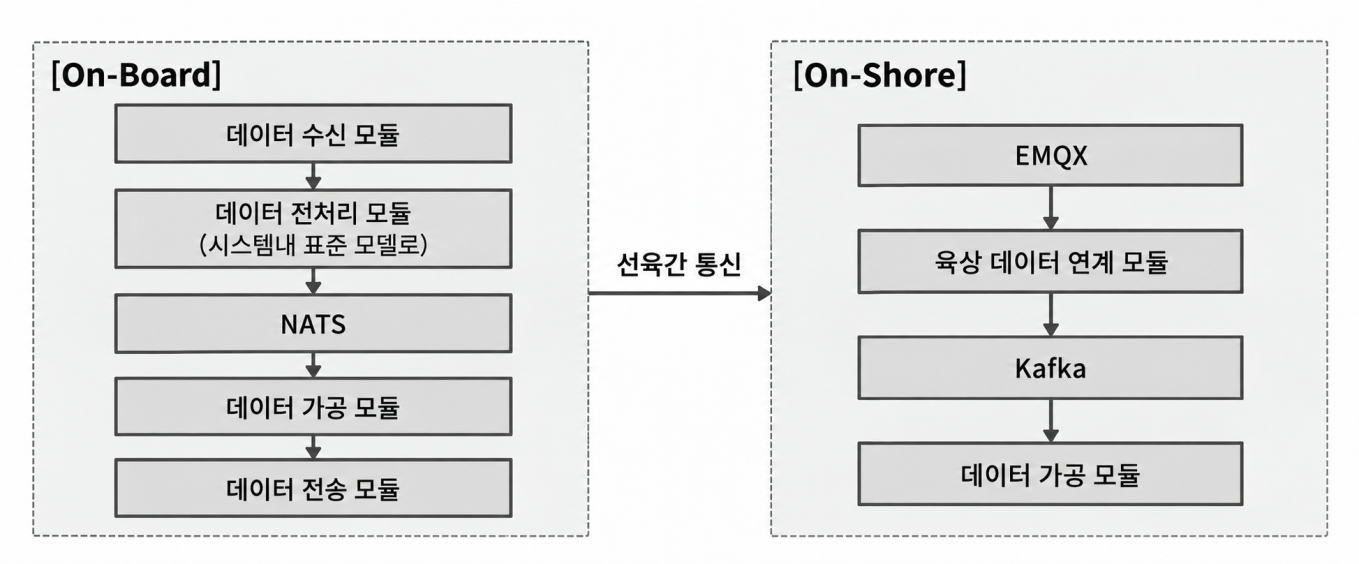
Therefore, even when the same single record is missing, the cause may differ.
If the data generated onboard is insufficient, the onboard generation and processing sections—such as the data reception module, data preprocessing module, and data processing module—should be checked first.
Conversely, if onboard data is generated normally but the number of records received on shore is insufficient, the inter-site network after the data transmission module, EMQX, the shore-side data integration module, Kafka, and the shore-side data processing module can be inspected.
The meaning of this structure is clear.
Rather than stopping at the symptom “there is no data,” we must go one step further and identify “how far the data got and where it disappeared” for actual recovery to be possible.
4. Step 3 — Possible recovery is performed onboard first
One of SS’s characteristics is that discovering data loss does not automatically mean that the shore-side operator requests the ship to retransmit the data directly.
Onboard, missing data is identified based on the data generation and processing Pipeline, and, when necessary, data that can be recovered independently is processed again.
The overall flow can be simplified as follows.
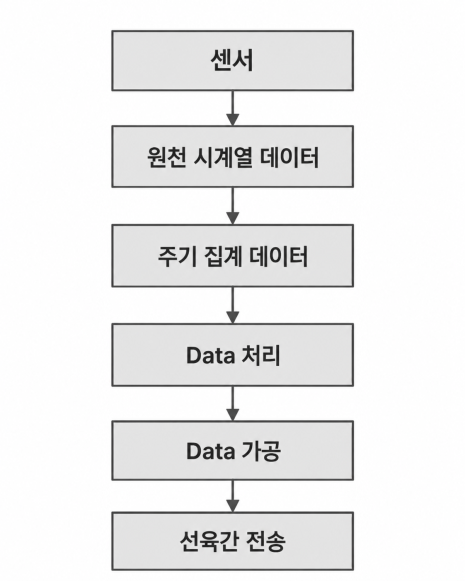
Because periodic aggregated 1-minute data later serves as the criterion for determining the consistency of data loss and recovery management on shore, it is important that it be generated and maintained normally onboard.
The scope of data loss and recovery management includes onboard and shore-side data processing, data monitoring, onboard sensor data collection, data preprocessing, shore-side data integration, and Kafka integration, while its main activities include identifying suspected losses, reprocessing, and finally confirming recovery.
In other words, data consistency is not viewed as the responsibility of a single central system,but as a structure in which roles are divided so that recovery can also be performed on the ship where the data is generated.
This can be expressed in one sentence as follows.
“Rather than simply waiting for the network to be restored, we enable recovery to be performed first at the location where the data exists.”
5. Step 4 — On shore, confirmation and retransmission through the shore-side data integration module are managed as a single status process
If the data still cannot be confirmed on shore after onboard recovery, a shore-centered recovery procedure follows.
The important point here is that discovering missing data does not immediately mean requesting the ship to send the same data again. First, the shore-side data integration module is checked for whether the data exists and whether retransmission is possible; only if the data still cannot be recovered does the process proceed to the onboard retransmission stage.
Shore-side retransmission request → Detection of the recovery target onboard → Recovery processing by the data processing module → Receipt of BackfillResponse and reflection of the result → Retry after response delay or failure
For users, this recovery process is simplified and displayed in the form of statuses.
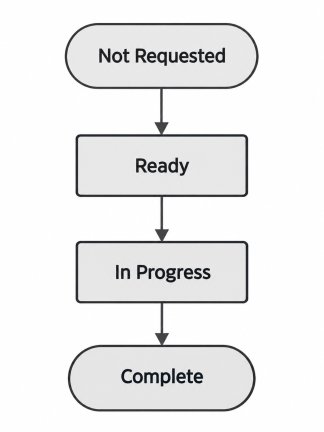
Data loss and recovery management also provides functions related to Daily retransmission.
In this structure, retransmission is not simply a button or a single API call, but
missing data detected → retransmission feasibility determined → request → processing → actual recovery confirmeda process with the status ofRecovery Workflow .
6. Step 5 — Distinguish between ‘request success’ and ‘recovery complete’
A common error in data recovery systems is to regard a successful retransmission API call as successful data recovery.
However, what is actually required is not a 200 OK response to the request.
The retransmitted data must pass through the Pipeline again and arrive at the shore-side data processing module, and the actual missing Timestamp must be reflected in the reception history.
Therefore, SS’s recovery completion criteria are best understood as follows.
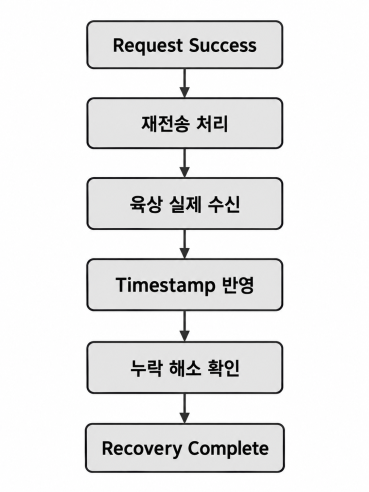
That is, Request Success ≠ Recovery Complete.
The purpose of data loss and recovery management includes not only detecting the loss section and requesting reprocessing, but also the procedure for confirming the final recovery result; operators can check the data reception status, Backfill events, recovery history, and Pipeline status together.
This is an important aspect of SS data consistency management.
The goal is not to build a retransmission function, but to measure again whether the result of the retransmission has actually been reflected in the system status.
7. Step 6 — Receiving all 1,440 records does not mean that the data is normal
Once this has been resolved, we can confirm the data’sCompleteness, that is, whether the required data exists.
However, one more problem remains.
Even if all 1,440 records have been received, the data cannot be used as-is for analysis or operational support if all 1,440 records point to the same value or continuously show abnormal ranges.
At this point,Data Anomaly Detection Management complements Data Missingness and Recovery Management.
Data Anomaly Detection Management is a function that checks sensor data from each vessel on land for anomalies on a daily basis, manages the history of alarm generation, persistence, and clearance, and delivers the results to the person in charge.
Its internal components include the vessel master, alarm conditions, vessel-specific alarm status, detailed history, daily aggregations, and mail recipient groups.
Users can configure the Alarm Condition, applicable vessels, and Recipient Group for each Tag, view the alarm status for each vessel, and export it as a CSV.
In particular, Stuck Alarm and Custom Alarm detect sensor data in which the same value persists for an extended period or that meets predefined conditions.
Therefore, SS's data reliability perspective can be divided into the following four stages.
|
Perspective |
Questions to verify |
Key function |
|---|---|---|
|
Completeness |
Does all the required data exist without omissions? |
Data Missingness and Recovery Management |
|
Continuity |
At which point was the connection broken, from the vessel to the shore? |
Pipeline Status Check |
|
Recovery |
Has the missing data been recovered? |
Backfill / Resend |
|
Validity |
Are the data values themselves valid? |
Data Anomaly Detection Management |
In other words, Data Missingness and Recovery Management checks whether “the data exists,” Data Anomaly Detection Management checks the next stage: “whether that data is in a usable state.”
8. Operational Perspective — Defining the Boundary Between Automation and Operator Intervention
As the number of data integrity management functions increases, another problem arises.
If operators manually check every situation, the operational burden also increases sharply as the number of vessels and the volume of data grow.
Conversely, if the system is made to automatically determine and handle every failure, it becomes difficult to control incorrect decisions or repeated resends.
SS separates the areas for automated processing and operator intervention between these two extremes.
The system continuously checks the data reception status, calculates potential data losses, and manages Backfill and recovery status. Data Anomaly Detection Management also checks vessel sensor data through a daily batch and processes the history of alarm generation, persistence, and clearance.
Based on these results, operators select specific vessels and dates, choose targets eligible for resend, and manage Tag status, Remark, Hazard conditions, and target vessels.
In other words, the operating philosophy can be summarized as follows.
“The system automates normal recovery processes that can be repeatedly determined and provides operators with situations requiring additional judgment in a clear status.”
The purpose of automation is not to eliminate operators, but to enable operators to focus on the problems they truly need to judge.
9. Conclusion — Ship-to-Shore Data Integrity Is Not a Single Function but a Closed Loop
If SS's data integrity management is viewed only as individual functions such as Data Missingness and Recovery Management or Data Anomaly Detection Management, the various functions may appear to exist in parallel, but they form a single connected flow.
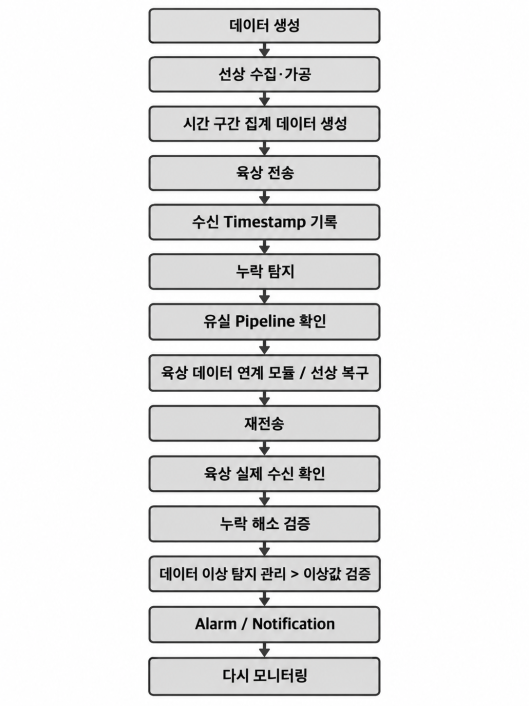
Rather than simply being a “resend function,” it is a Closed LoopIt is close to a data reliability management structure.
Data omission and recovery management verifies whether the one-minute data generated onboard was properly delivered to shore, and if any data is missing, it tracks down the cause, recovers the data, and then verifies the actual recovery results.
Data anomaly detection management rechecks whether the values of the data secured in this way are themselves normal, and if an anomaly is found, notifies operators through alerts and history logs.
Ultimately, the key to ensuring data reliability between ship and shore issending the data correctly oncenot.
It is to build a closed-loop management system that autonomously detects omissions, identifies where the problem occurred, and recovers the dataand then verifies again whether the recovered data has actually been reflected on shore, and finally checks the quality of the data values.That is what it means.
From this perspective, SS's data omission and recovery management and data anomaly detection management are not two independent functions, but rather
an End-to-End data reliability framework consisting of “data existence → delivery integrity → recoverability → recovery verification → data validity”in which they can be seen as handling the front and back ends, respectively.
sypark2