
- In 2026, the standards for Java-based backends have changed.
Changes over the past 8 months
As of July 2026, the main components of the Java backend stack have simultaneously undergone a generational shift over the past 8 months.

If we look at the new version changes of each technology separately during this period, it may simply be seen as changes over time. However, these changes are interdependent.
-
Spring AI 2.0 is designed based on Spring Boot 4.x and Spring Framework 7.
-
Spring Boot 4.x operates on Jakarta EE 11 and Jackson 3.
Such a chain of ecosystem changes soon demands a rapid transition in the practical field.
However, as has always been the case, it is true that the actual version distribution in the field is not keeping up with this pace.
[Azul's State of Java 2025 survey results]
-
Java 17 at 34%
-
Java 21 at 31%
-
Java 8 at 23%
The significant increase in the adoption rate of Java 21 is clear, but most environments are just now settling into Java 21 while facing Java 25. The problem is that as this gap widens, the transition costs increase. Skipping one generation means that in the next transition, you have to handle changes equivalent to two generations and the associated compatibility issues all at once.
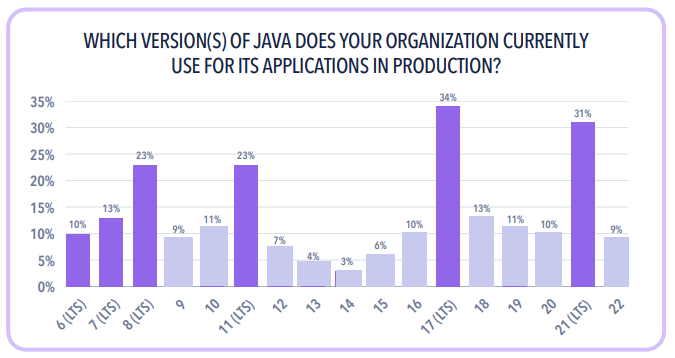
[Source] Azul-State of Java 2025
Course for Adapting to Change
The first step in adapting to change is understanding through learning. The reference documents or materials related to the technologies described earlier are all publicly available and of high quality. Additionally, using AI, you can get answers in seconds about what APIs have been added in Java 25 and what has changed in Spring Boot 4. The cost of accessing individual knowledge has never been lower.
However, from a developer's perspective, beyond learning new technologies, it is still the developer’s responsibility to determine what and how to change in the services that are currently in operation, how far to go, where to stop, and how to explain the basis for those decisions to the team. Knowing the technology and making transition decisions are different areas. This lecture emphasizes the latter.
Namsoori has prepared a practical curriculum that organically encompasses each topic as follows.
|
Part |
Topic |
Details |
|---|---|---|
|
Part 1 |
Java 25 |
- Validation of Migration from 21 to 25 |
|
Part 2 |
Spring Boot 4.x |
- Framework 7/Jakarta EE 11/Jackson 3 Migration |
|
Part 3 |
GraalVM Native |
- Native Image Principles |
|
Part 4 |
Spring AI 2.0 |
- Spring AI 2.0 Architecture |
[Key Points by Part]
* Part 1 Key Point: The important factor in moving between LTS is not just simple compile errors, but operational compatibility. Even if it passes staging, we check for risks that may arise in the production environment due to changes in runtime semantics.
* Part 2 Key Point: This is a period where standalone upgrades are not possible. Since three foundational stacks are being updated simultaneously, we proceed based on an understanding of the order and impact range.
* Part 3 Key Point: Understand build-time constraints such as reflection, dynamic proxying, and resource loading, and build runtimes optimized for cloud-native environments.
* Part 4 Key Point: With the 2.0 release, Java's AI integration has entered the practical stage. We cover AI integration knowledge from the perspective of backend engineers, including embedding, vector search, and failure points of RAG.
Each part does not use different examples. It proceeds by layering the changes of the next part onto the code modified in the previous part, based on a single example project. Practical transitions always occur on code that is already running.
This course is not designed for beginners. It does not explain concepts like streams, lambdas, DI, or AOP. Therefore, it is prepared for developers who have developed or operated services at least once based on Spring Boot.
The entire course is produced in about 30 episodes and is scheduled to be released sequentially every week. Through these lectures, I hope many developers can check their migration checklists for services and gain an understanding to assess the impact range. I hope it helps in understanding and adopting the newly updated technologies.
|
This course is based on Java 25 (LTS), Spring Boot 4.x, GraalVM, and Spring AI 2.0 as of 2026. Preview-stage features and ongoing releases may change later, and the structure and order of the lectures may also be adjusted during the production process. |
|---|
-
Link to the playlist: https://www.youtube.com/playlist?list=PLJEMCFWm_9TQ
-
Namoosori Channel: https://www.youtube.com/namoosori
Jin