
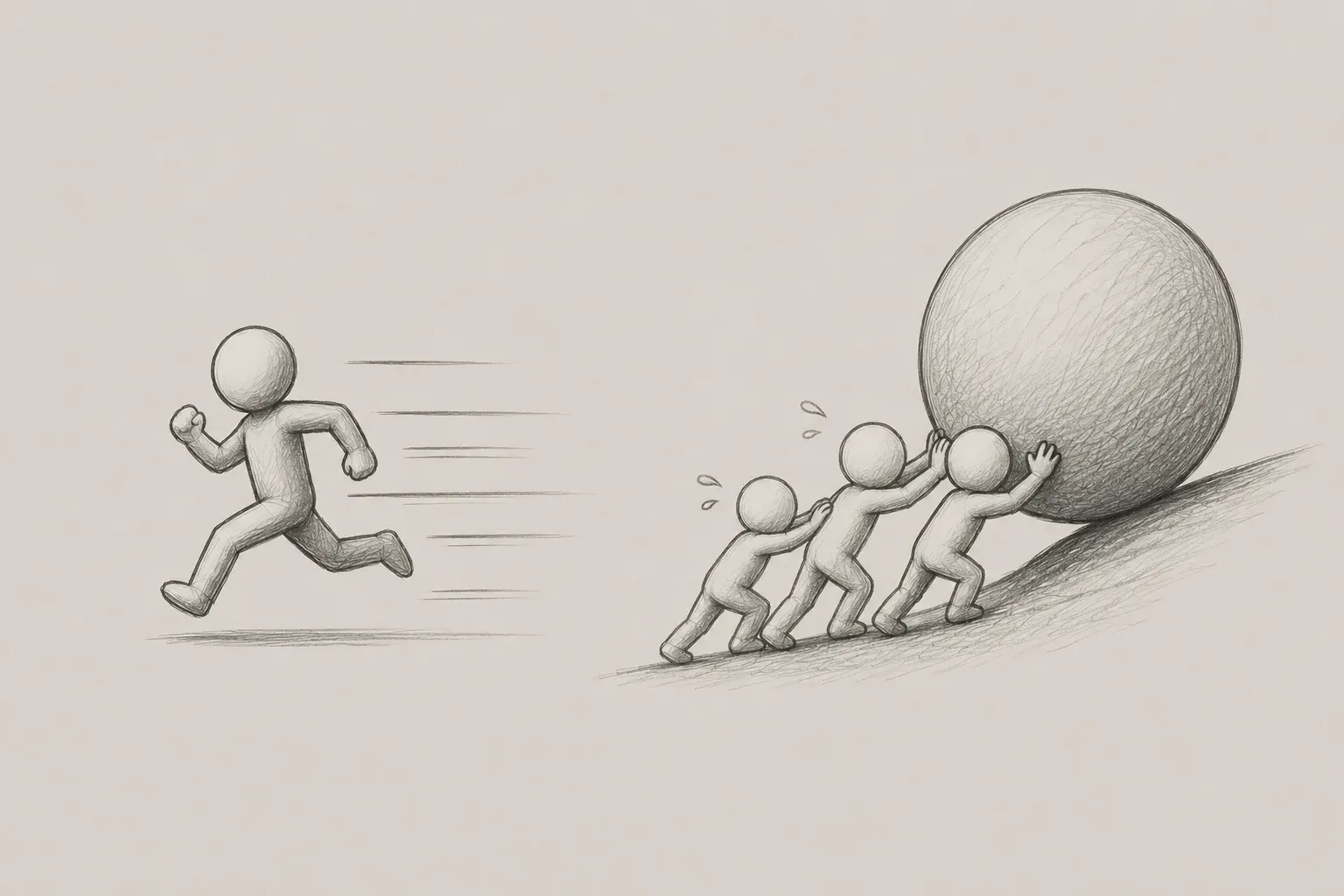
- The use of AI has accelerated code and document writing, but it does not directly translate to the team's progress. To connect an individual’s work speed to the team’s productivity, we assess the absorptive capacity required, based on the criteria of detectability, traceability, and recoverability.
At first, I thought it would be enough to refine the AI workflow I was using and share it with the team. I expected that organizing and sharing the rules and commands would expand the speed improvements I experienced to the team.
However, the actual bottleneck was elsewhere. Thanks to AI, the code and documents were produced quickly, but that speed did not fully carry over to the team's pace.
Investigating why this difference occurs Absorptive CapacityI learned about the concept. Recognizing the value of external knowledge and information, and the ability to transform and utilize it with internal team capabilitiesis.
The code and documents created by AI are, at first, close to external knowledge. Even if it appears to be within the team, it does not immediately become the team’s capability.
The bottleneck has shifted from writing to absorption
Even before AI, there were PRs that lacked context or were formal reviews. However, back then, the outputs did not accumulate as quickly as they do now. It took time to write code and polish documentation, and that time allowed the author a moment to reconsider their choices.
AI has significantly reduced the time it takes to produce initial results. Now it quickly delivers designs, code, and tests even in unfamiliar areas.
However, there is a difference between appearing to be complete on the surface and being at a level that the team can accept. We need to consider whether it has been validated against the team's standards, how far we have verified, what is still outstanding, and whether the context remains for the next person to take over.
Teams equipped with this approach transform increased individual productivity into team progress. Conversely, teams that lack this approach find their accelerated pace leading to bottlenecks instead.
Being in a team does not make you part of the team's knowledge
AI-generated outputs easily integrate into the team's workflow. The code goes to the repository, documents are left in the wiki, and analysis results become agenda items for meetings. On the surface, everything appears to be the team's assets.
However, the judgments made during creation will not be conveyed if not separately recorded. The judgments left only in the AI session and conversation logs do not become the context for the team.
Although the format is in place like this, it produces outputs that do not advance the work and shift the burden of interpretation and verification to the recipient.WorkslopIt is said. The problem does not end simply with increased review time. When you receive such outputs, it not only increases the review time but also undermines the trust within the team.
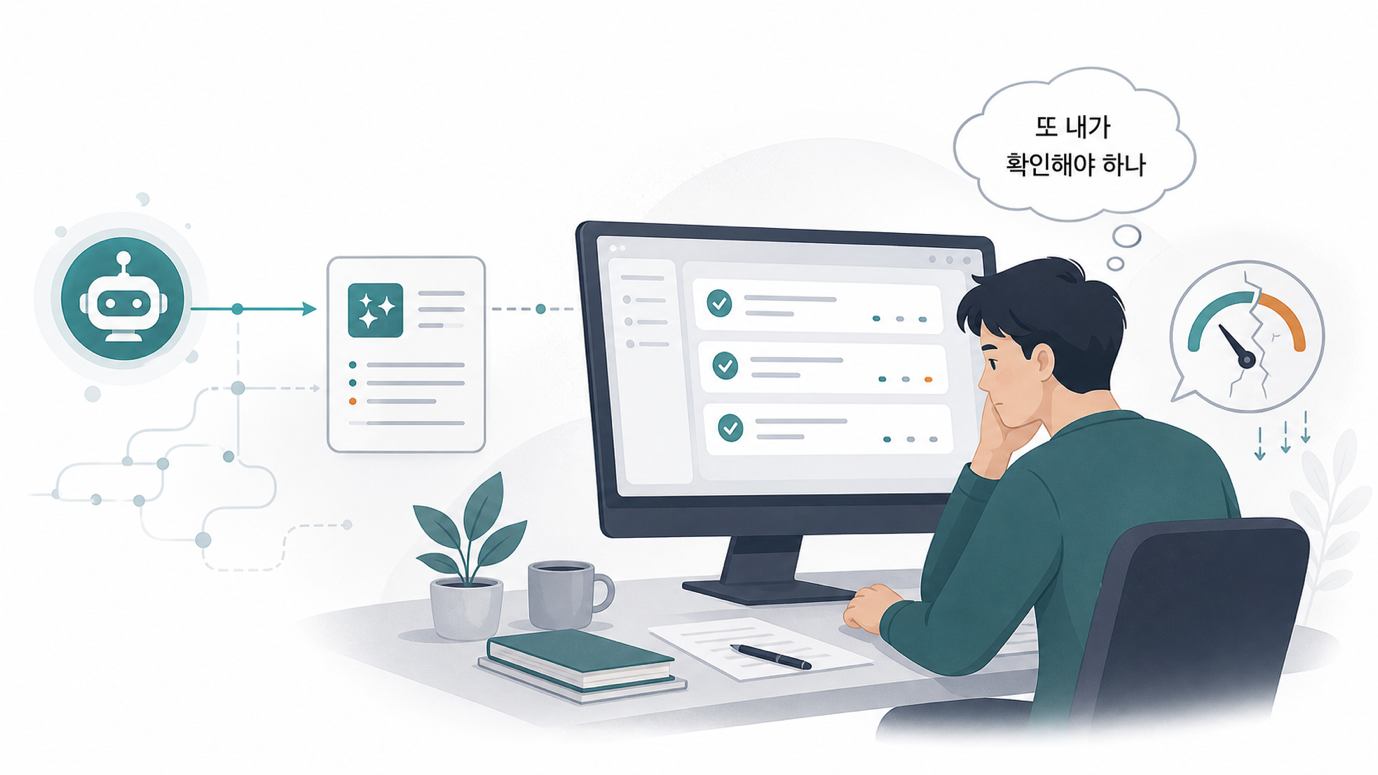
This is not a matter to be left to the meticulousness of individual writers. If the workflow is repeated, we need to first look at the conditions under which the team is accepting the deliverables.
Three conditions to become an asset to the team
To become an asset to the team, the deliverable must be able to answer three questions.
-
Can it be judged based on the criteria agreed upon by the team?
-
Can the grounds for a decision be traced over time?
-
Are you able to quickly recognize and correct or revert when something goes wrong?
This question applies not only to code but also to all deliverables that the team inherits, such as documentation, technical decisions, and operational policies.
Judgment capability
ReviewabilityIt means that the output is sufficiently substantiated for a third party to understand and evaluate. It is not simply a matter of readability. It should be organized as a single review unit, and it must clearly indicate what problem it aimed to solve and the extent of its impact.
This also means that it should be viewed according to the criteria agreed upon by the team. Even if it looks plausible, if it deviates from the architecture, naming, exception handling, and testing methods agreed upon by the team, it is difficult to accept it as the team's asset. Particularly, AI outputs often appear to be highly complete, which can create an illusion of having been validated, making it challenging to judge the reality.
Traceability
TraceabilityThe issue is whether we can follow the basis and connections of decisions even after time has passed. Using AI, the results can be produced quickly, and conversation histories or summaries can be kept. However, just because there is a record does not mean the team can understand it immediately. It is essential that there is a documented form that outlines what problem was started, what judgments were made, and how they led to code, documents, and results.
This way, you won't repeat the same judgment later, and you can reconsider the existing decision when the situation changes.
Recoverability
Recoverabilityrefers to the ability to quickly recognize and correct issues when they arise.
The results produced by AI may look plausible, making it easy to pass the review process, but unexpected risks may emerge later. Therefore, the goal is not to completely eliminate mistakes, but to create a system that allows the team to safely manage issues within a manageable scope when they occur.
Criteria to Check at the Boundary of the Team
It's okay if individual work styles differ. However, when the results cross team boundaries, the three previous conditions must be verified.
Let's take a look at the most familiar example, PR.
This is part of a PR worked on in the manner discussed in the previous post - AI Agentic Workflow over 60 Days.
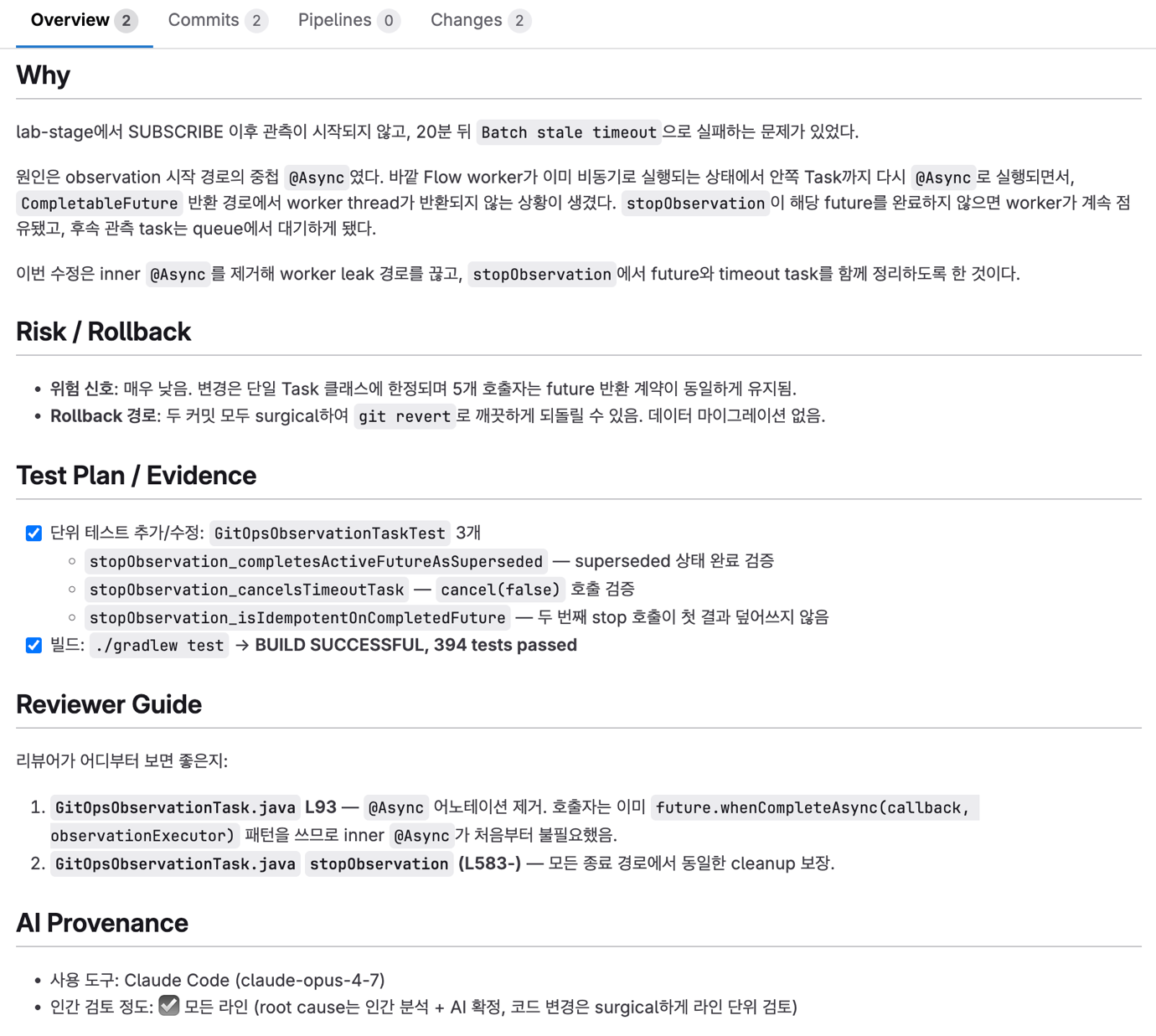
It's not just about writing the PR text in detail. It's about understanding the root cause of the issue, what has been validated, what the reviewer should look for, and how to respond if a problem arises, ensuring that the team does not miss any necessary information before acceptance.harness)must be.
However, relying on the author's diligence to write this every time is not sustainable. It should be integrated into the team's workflow, not just an individual's checklist. Regardless of which tools are used, the same quality of information should remain when crossing team boundaries.
The criteria for a good PR have not changed since before AI. However, now that an amplifier called AI exists, what used to be good practices to adhere to has turned into a much greater cost to pay if not followed.
The team's progress comes from absorption
AI has not set a new standard that didn't exist before. However, as the speed at which AI outputs come into teams changes, the strengths and weaknesses of existing engineering systems have begun to emerge more quickly.
A solid team that embraces the process of taking individual work under team responsibility can absorb the speed increased by AI into the team's productivity. Conversely, teams that lack this process may only see an increase in the speed of generating something, but the team struggles to move forward.
The bottleneck points can vary by team. However, if an individual's writing speed has increased but the team's progress remains the same, we need to first check whether the team has a system in place to handle that speed.
What has been said so far teamis personIt does not mean just that. The entity taking on the next task can be a person or an AI. The AI also operates based on the context left for the team. If the context is empty, it spends resources to infer that content again, and trying to fill the gap plausibly can lead to hallucinations or incorrect judgments.
What organizations should focus on is not how much they have used AI or how many outputs they have produced.
Is the team absorbing the outputs generated by AI as knowledge that they can take responsibility for?
If we cannot answer this question, the increased speed will remain a burden that the team has to repay.
References
- Cohen & Levinthal, ["Absorptive Capacity: A New Perspective on Learning and Innovation"] (Administrative Science Quarterly, 1990)
- Kate Niederhoffer et al., ["AI-Generated 'Workslop' Is Destroying Productivity"] (Harvard Business Review, 2025-09)
TaeZ