

-The story of building a multi-agent production team at Edulime Academy-
I wanted studying Korean to be as addictive as binge-watching a drama. The kind of experience where, after watching one episode, you want to press play on the next. Instead of turning on a video because it was homework, I wanted learners to keep watching because they were curious about what would happen to those two people. As they followed the story, they would suddenly realize they could understand the dialogue—and then try saying it themselves. That was the learning experience I wanted to create at Edulime Academy.
So I put writers and directors on the production team teaching Korean from the very beginning. A writer, a Korean-learning editor, a drama reviewer, a production director, and a video and sound reviewer. I assigned these five roles to AI agents. Judging by the roles alone, it was practically a small production company. There was no commuting, and no need to reserve a conference room. When I distributed the work in Codex’s main chat, each agent brought back the results of its assignment.
But at some point, I realized that what I was doing looked like this: revising a line asking why someone had come when they had never been invited, looking for a plate that had disappeared when the shot changed, and demanding to know why the mouth of a character sitting on the floor was not moving. Then I asked them to revert it, saying the previous version was better than the newly created performance.
There was no employee whose labor costs I had to calculate, but very specific things to check began appearing. Everything from whether the friend in the script had been invited to the inventory of plates became my responsibility. I had called in a writer and a director, but I was moving between the roles of producer, viewer, and props manager.
By actually writing the scripts and revising the videos, I gradually learned what to entrust to this production team and what I needed to take back myself. Even deciding whether to discard a single cup required more hands than I expected. I want to unpack everything from that cup story to the reason I reverted the final version to an earlier one.
There is a production team, but still no broadcasting station
Edulime Academy’s goal is to make learners want to keep coming back to study Korean. Drama was the format I chose to pursue that goal. While the characters are dealing with everyday events, we do not interrupt the story. After the drama ends, learners listen to and repeat expressions selected from the actual dialogue. They might start watching because they want to know why the friend cannot throw away the cup, then go on to say the Korean that friend used with their own voice.
We also work on short promotional videos, but this article focuses on the experience of creating the academy’s dramas and speaking practice. The first problem we had to solve during production was clear. Collecting grammatically correct sentences does not make viewers curious about the next episode.
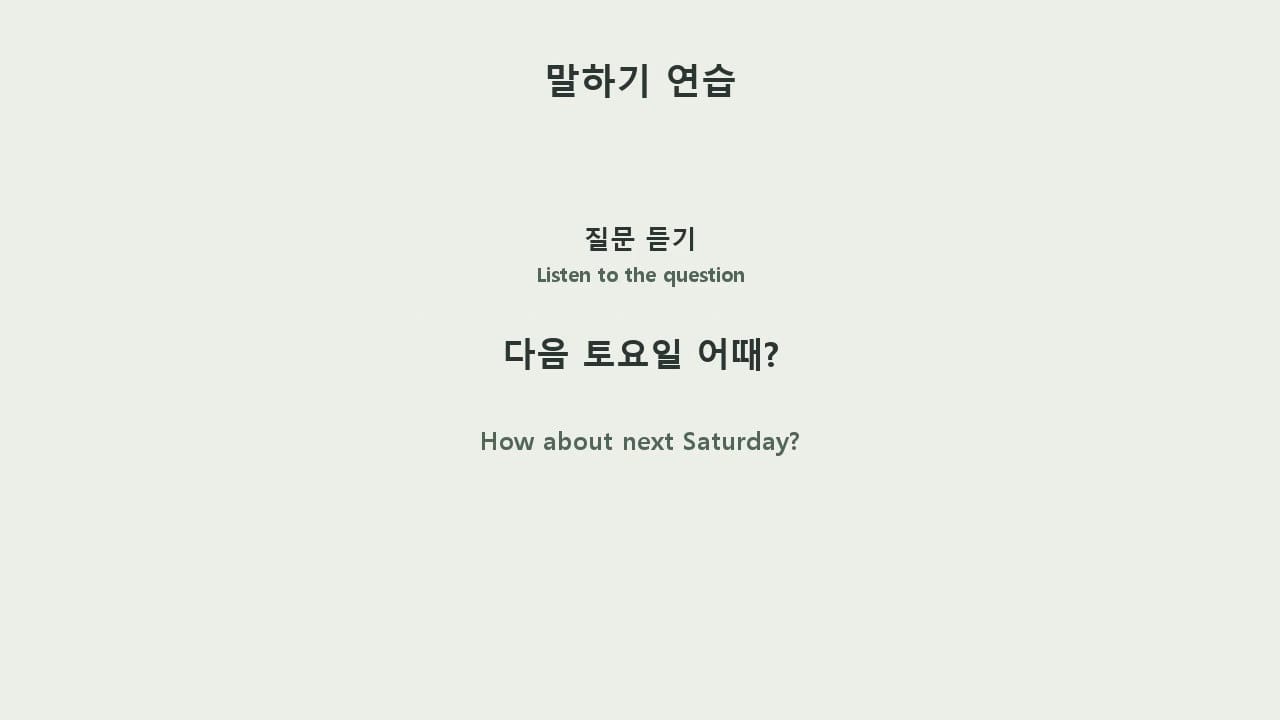
The actual speaking-practice screen from 「Before Throwing It Away」. This is the section where learners listen again to a question they heard in the drama and repeat it.
This goal combines several different tasks at once. Viewers need to be curious about what a character will do next, and the Korean dialogue also needs to sound natural. The English subtitles must follow the original meaning, and if a character is holding a cup, their hand must not pass through it. During the practice section, it is a problem if the video moves on to the next sentence before the viewer has even had a chance to open their mouth.
That is why I defined five specialist roles inside Codex. I broke the broad request “Make a good video” down into tasks that each role could verify.
|
Role |
Assigned responsibilities |
|---|---|
|
Writer |
Writing the story and Korean script, and incorporating revision feedback |
|
Korean-learning editor |
Reviewing the naturalness and speech style of the dialogue, the English subtitles, and the practice expressions |
|
Drama reviewer |
Reviewing the characters’ actions, the progression of events, and the reasons to keep watching |
|
Production director |
Checking production feasibility and assembling the voice, composition, artwork, and video |
|
Video and sound reviewer |
Reviewing the performances, visuals, subtitles, and practice sections in the actual finished product |
I assigned the role of coordinating them to the main chat. In that chat, I describe the direction I want and look at the results. The main chat calls in the specialists it needs and tells them exactly which files to read, what to revise, and how far to proceed. It receives each specialist’s output, passes it on to the next person in charge, and records the version I selected.
Five is the number of roles. It does not mean that I always have five agents running simultaneously. There is no reason to call in the video reviewer when reviewing a script. Conversely, when I had two different scripts written, I once divided the same writer role between two agents. In fact, for one five-episode script project, two writers divided the work between them.
The project’s role-definition files contain descriptions and instructions for each role. But writing “production director” in a file and having a running agent receive those instructions and work from them were separate things. During the actual call, I had to provide the relevant role and the scope of that particular task. Making someone a business card did not mean the handoff of responsibilities was complete.
The first task was fixing Korean so that it sounded like Korean
The initial pilot script contained lines like these.
“Yes, I’ll just check the time.”
“I took a quick look at the place, too. But I can’t take care of everything. I came as a guest today.”
If you separate the sentences, their meanings are understandable. But when I looked at who was saying them and why in the scene, the conversation felt awkward. I gave the feedback that it sounded as if content conceived in English had been transferred into Korean. I do not know what language the actual model was thinking in. What I could confirm was the resulting dialogue and the preceding planning materials—and that the result did not work well as a Korean conversation.
By this point, the internal review had already concluded that the script was ready. This problem had occurred even though we had assigned a role specifically to review the Korean. Adding experts may seem as though it will reduce the amount of checking required, but we also had to examine the criteria the experts had used to approve something.
The revision did not end with replacing a few awkward words. The writer first wrote the Korean scene and dialogue, and the learning editor read only that dialogue without an English translation. We changed the process so that, after checking whether the response properly addressed the previous speaker’s request, whether someone in this relationship would actually say such a thing, and whether the character was asking for the information they really needed, we would then add the English subtitles and practice expressions. Later, we also organized the process so that the creative directions and revision feedback given to the writer were written in Korean.
That did not mean that saving the Korean file first would automatically produce a natural script. I sent back the short dialogue that came afterward as well. The situation could only be understood by reading the explanation, and the scene itself was not interesting enough. After fixing the Korean sentences, we had to revise the drama again. The production team’s first assignment lasted longer than expected.
An uninvited visit that a grammar check could not catch
A similar problem appeared in a smaller but clearer form in 「This One’s Mine」 from the next batch of scripts. After a conversation in which a friend suggested some equipment, the line “Are you coming, too?” appeared. The friend asked as though the other person had decided to visit, even though they had not yet invited them to come over.
“Are you coming, too?” is not incorrect Korean in itself. If someone has already decided to come, it is perfectly natural. That premise was missing from this script. The sentence looked fine on its own, but one friend had effectively entered the conversation through a gap in the dialogue.
The revised line was “Yeah. Come over and give me a hand.” This directly requests both a visit and help in that moment. The learning editor’s review criteria also became clearer. They had to examine not only honorific and casual speech and translation accuracy, but also the order in which the request, invitation, and agreement occurred.
Another question remained for the drama reviewer. The actions in the script had causes and consequences, and the internal review had passed it. Still, I said that although it was realistic, I was not sure it was interesting or dramatic enough. There was still a distance between something that could happen and something people would want to watch.
It might seem that calling in one more reviewer would produce the answer, but the records from that time did not support such a conclusion. Instead, we had to change how we interpreted review results. Saying “We did not find any major structural problems” is useful. If we take that to mean “Viewers will find it entertaining,” we are treating unperformed validation as though it were already complete.
Still, an old cup became a reason to make the production
The story I chose from the same batch because I wanted to produce it was 「Before Throwing It Away」. Sua is sorting through her belongings for a move, and Minho is helping her. Minho sees a cup with a handle that was clumsily attached and asks whether he can throw it away. Sua says she will not use it, but that she will take it with her anyway.
Minho: “If you like that cup, I’ll buy you a new one.”
Sua: “Not a new cup. This one.”
Minho: “Why?”
Sua: “Because you put the handle back on.”

A scene from the 「Before Throwing It Away」 V5 video. The line “Because you put the handle back on” contains the reason she keeps the cup.
It was a cup that Minho had broken and then repaired himself. Minho thought he had fixed it well, but Sua stopped using it the next day because the handle wobbled. She was not keeping an object because the repair had succeeded.
Later, they talk about how it takes about an hour by bus to reach the new house, and Minho says it will be difficult for him to come as often as he does now. Sua stops while packing the cup. The scene about whether to throw away an object shifts into a scene about worrying that their routine of dropping by comfortably might disappear. Rather than ending with the vague promise that they would keep seeing each other, the two of them set a date for the next visit and make plans for dinner.
Even the drama reviewer viewed the story’s emotional flow favorably at the outline stage. At the same time, they suggested revising it so that the cup with the attached note would remain as a keepsake, while a separate, intact cup would be used for actual drinking. The ending therefore included the action of leaving one cup to use on the last morning before the move. This was an example of review moving beyond abstract praise to concretely define a choice to show on screen.
I liked the story as well. However, I suggested changing “You can’t just come over anymore” to “You won’t be able to come over as often anymore.” What Sua regretted was that the number of visits would decrease. To match that meaning, Minho’s next line was also changed to “Then let’s make a promise and go.” The English subtitles and practice materials were updated accordingly.
This small revision is a good way to explain multi-agent work. One person identifies the intent, the script specialist incorporates it, and the connected responses and translations are checked. If each person polishes only their own sentence, different meanings remain in the revision. That is because there is one script, but review comments come from multiple places.
This story may have required more new artwork than the other candidates: a hand holding up a cup, a packing pose, a box, a drawer, and so on. Even so, I decided it was worth producing. The production supervisor’s role was to make the necessary work visible, while I decided whether the story was good enough to justify taking on that work. If we chose scripts based only on the artwork we already had, the characters would end up in similar poses having similar conversations every time.
Our production team does not edit the script simultaneously
At this point, merging revision feedback becomes more important than dividing up the roles. While the writer is revising the dialogue, the editor may translate an earlier line, and the reviewer may read an even older file. All three can work diligently and still produce inconsistent results.
So we assigned dialogue IDs to the script. Sua’s line revised earlier is E05-S03-L009. Instead of specifying its location as “the somewhat awkward line in the latter half,” using this ID lets us trace it through to the very next response and the English subtitles. We also kept the file version and hash so we could distinguish which manuscript had been reviewed. We could use the reviewer’s positive assessment only if the script they approved was the same one I opened.
We designated a single person to edit the manuscript directly. The learning editor proposes revisions, the drama reviewer returns problems and supporting evidence, and the writer integrates everything into one script. Independent reviews can proceed in parallel against the same fixed version. We treated editing the manuscript simultaneously and reading the manuscript simultaneously as different things.
We also made sure that work instructions did not consist only of sending a role name. The following is a brief example of the handoff items we defined; it is not a verbatim reproduction of a specific call log.
Target: The Korean script frozen this time and its exact version
Confirmed: The selected character relationships and the direction of the story
This time: Review the awkward dialogue and the response that follows it directly
Result: Problems and revision suggestions by dialogue ID
Scope: Review only; do not directly edit the script or generate audio
It was also important to distinguish what had been approved from what had not yet been decided. The decision that “this story is good” was not automatically a decision that “this voice is good.” Even if the writer had written it and the reviewer had deemed it ready, we did not let the system automatically decide whether to create the next paid voice recording. In ordinary workflows, we reviewed the script, voice, storyboard, required artwork, and finished video at the appropriate stages.
Conversely, I did not want to be called for every intermediate file. Once the storyboard and the plan for the required artwork had been confirmed, I asked the team to proceed with production and internal revisions within that scope and then show me a finished candidate. I had not assembled a production team with revision authority only to approve every time a file containing a single blink appeared.
The main chat coordinating the work needed both of these boundaries. Proceed within the assigned scope, and bring it to me when a new decision is needed. If the same opinions keep recurring without improving the result, do not keep passing the script back and forth between agents; show me what remains unresolved.
The art library had mouths, but the actors in the video did not speak
After the script, we create the voice, prepare the framing and artwork, and assemble the video. Here too, simply dividing up the roles did not guarantee that the result would fit together.
In one video version of “Before Throwing It Away,” I asked why the character neither spoke nor blinked. We did have existing character artwork with mouth and eye states. However, it was designed for a standing pose. The actual video used a newly created sitting-on-the-floor pose, and that artwork had no corresponding facial states. Since the head angle was different, we could not simply insert the standing face as it was.
A report that the assets existed was different from the fact that they worked on screen. Afterward, we created mouth and eye states that matched the floor poses actually being used, and revised the setup so that only the speaking character opened its mouth. The production specialist created the video, and the video reviewer had to verify that the poses used in the result actually spoke and blinked.
Something similar happened with props. A cup, box, and drawer drawn as temporary assets remained in the finished candidate, and internally this was treated as a known limitation. To me, the props essential to the scene were still underdeveloped. The memory connected to the cup was at the center of the story; if the cup was merely a temporary shape, it did not help much no matter how carefully the explanation was written.
In another café test, three plates became two when the shot changed. There was no scene showing anyone clearing them away. In the end, we revised it so that all three remained throughout. During review, we had to look not only at the attractive still frames at the beginning and end, but also at how objects changed across consecutive shots. I was making Korean educational content, but the revision request that day was to restore a missing plate.
The production team’s work instructions changed accordingly. Instead of reporting that “the image library has the functionality,” they had to verify the states that actually appeared in the video and leave untouched anything the reviewer could not hear or see through continuous playback. Whether a file opened normally and whether the acting felt natural were separate things that each had to be checked.
The agents could not all take a seat at the table
There were practical operational problems as well. For one batch of scripts, we tried to run an independent learning editor, but the execution environment’s agent limit prevented an additional call. The main chat performed that review instead.
If the record simply said “learning review complete,” it could appear that all five roles had reviewed the work independently. So we distinguished who had actually run and who had substituted for whom. We also could not hold an editor who had not actually run responsible for issues they had missed. The organizational chart had five slots, but that day’s work record had to be read separately.
We also adjusted how we accumulated failure cases. Instead of making every agent read the entire list of issues identified so far each time, we kept individual incidents with their respective episodes and incorporated only reusable principles into the shared guidelines. You do not need to memorize the number of plates or the cup’s position in the previous video to write the next script. You need the principle that an object’s state must carry across shots, along with whatever records are necessary for the current scene.
Nor did we assume that an agent already working would automatically receive new content just because we had edited the guidelines file. When assigning the next task, we explicitly conveyed the revised instructions. This was not about retraining the model; it was about changing the instructions and verification criteria for the next task.
We still cannot generalize from this whether the process became faster or cheaper than using one agent. Dividing the roles makes it possible to write and review in parallel, but it also creates work to hand off, consolidate, and revise again. What the records can show for now is that we produced multiple scripts, selected a story to produce, and ultimately obtained a video chosen by a person after revisions. There was too much work in between to explain productivity simply by counting agents.
Another final version appeared right after the final version
In the later production “Your Face Is Louder,” the earlier version was better than the new version with revised acting. I asked them to finish with the earlier one. The selected line retained the flavor of the question, “What’s going to pop out now?”
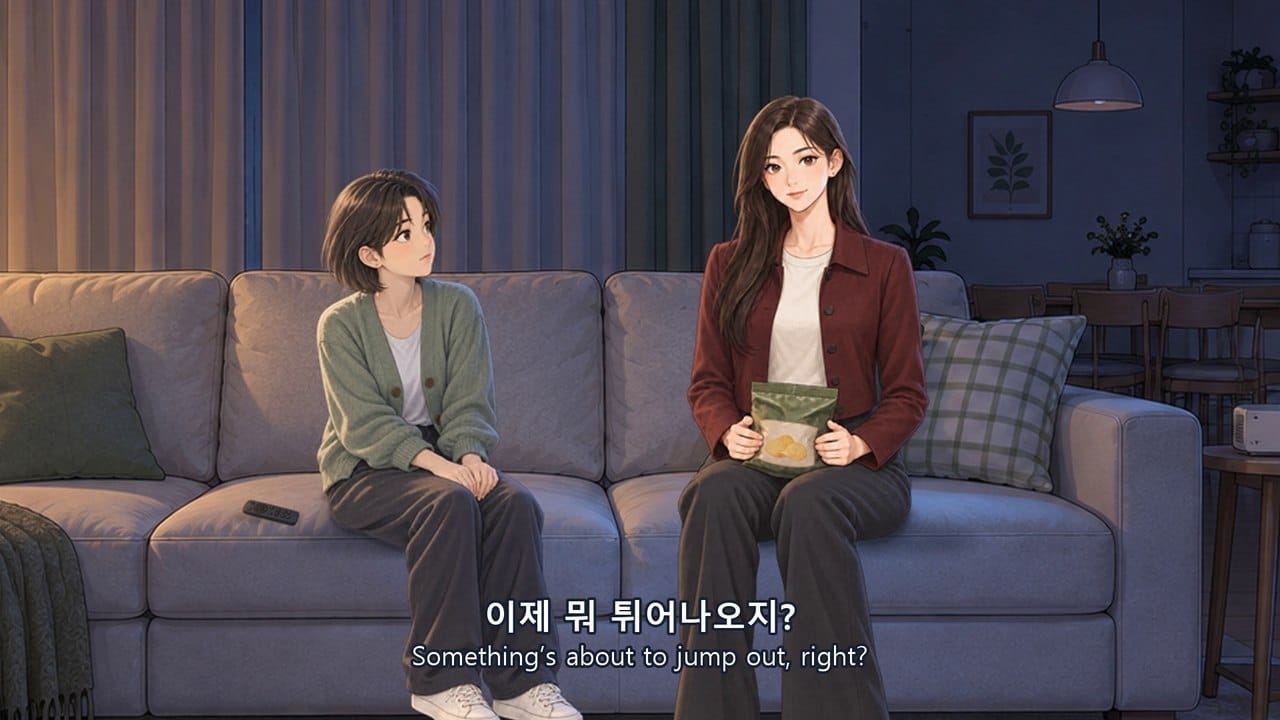
The actual screen from the selected V11 of “Your Face Is Louder.” The acting in this line was better in the earlier version than in the new one.
In a situation like this, the production team’s job is not to recreate something similar to the earlier version. It is to restore the earlier file I selected exactly as it was. The record retained both the selected V11 and the rejected V12, and the final file was restored to be byte-for-byte identical to V11. This restoration required no new voice or image generation.
At first, we divided up the roles that would create the deliverables. In actual operation, we also had to divide up responsibility for preserving selected results. When I asked them to change the cup’s position, the acting I had already chosen could not change, and an earlier choice could not become invalid simply because a new version had appeared.
What the agents brought back were scripts and artwork, review comments, and finished candidates. I chose which of them fit the project. On some days I sent a line back because the dialogue sounded unnatural; on others I said that we should make more artwork if necessary and produce this story. In that process, the main chat became the place connecting the production team’s work with my decisions.
After hiring five AIs, my task list included approving scripts, choosing performances, and checking props. It is a fairly plausible producer’s job description. Of course, the messages I actually sent were a little more modest. Translated into Korean, the final request was this:
“I liked the earlier version better. Please finish with that one.”
Joseph